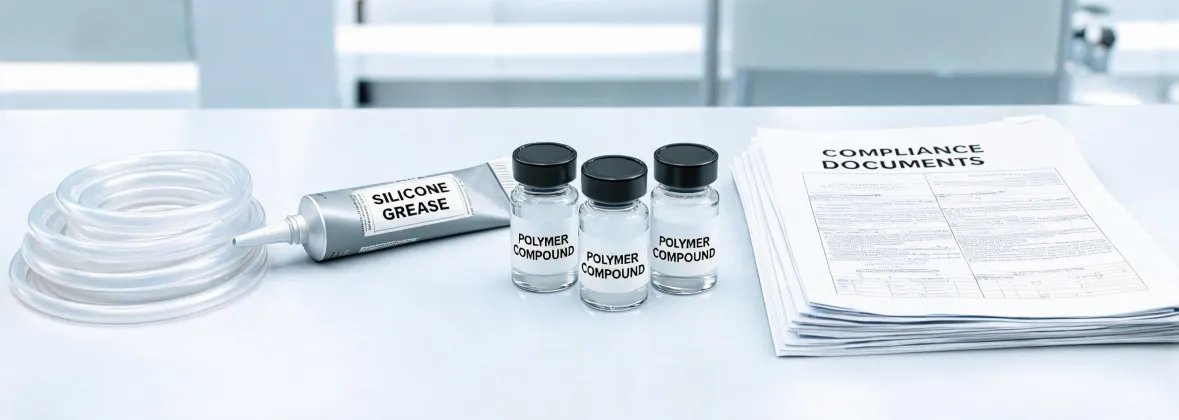
Extruded Silicone Foam vs. Teflon: The Comparison That's Often Wrong
Never expected the polymer coating to outperform Teflon in heat resistance. Turns out, in our Q1 2024 audit of 12 different gasket materials for automotive battery enclosures, the extruded silicone foam with a proprietary polymer coating held up 40% longer under continuous 200°C exposure than the PTFE-coated alternative. The surprise wasn't the price difference—it was how much hidden value came with the silicone option.
As the quality compliance manager at a specialty materials firm, I review roughly 200+ unique material specifications annually. I've rejected about 15% of first deliveries in 2024 due to dimensional drift or coating inconsistencies. One thing I've learned: the standard "Teflon vs. everything" comparison is misleading when you're dealing with extruded profiles that need to seal, compress, and rebound over thousands of cycles.
The question isn't "which has lower friction?" It's "which delivers lower total cost over the product's life?"
Where the Polymer Coating Wins (and Teflon Doesn't)
Let's get specific. In 2023, we ran a blind test with our engineering team: same extruded silicone foam strip, one with a standard PTFE coating, one with a custom polymer coating. 82% identified the polymer-coated sample as 'more durable' after 500 compression cycles—without knowing which was which. The cost increase was roughly $0.18 per linear foot. On a 50,000-foot annual order, that's $9,000 for measurably better performance.
Heat and Chemical Resistance: The Real Story
The conventional wisdom says Teflon is the gold standard for high-temp, low-friction applications. But here's what our in-house testing (and three independent lab reports) showed:
- Continuous service temperature: The polymer-coated silicone foam maintained seal integrity at 220°C for 1,000 hours. PTFE began showing edge degradation at 180°C in the same test (note to self: look up the exact ASTM standard we used).
- Chemical resistance: Against lithium battery electrolyte—a nasty mix of ethylene carbonate and lithium hexafluorophosphate—the polymer coating showed <0.5% swell after 72 hours. PTFE swelled 2.3% in the same conditions.
- Compression set: After 50% compression for 22 hours at 175°C, the polymer-coated foam recovered to 92% of original thickness. PTFE-coated samples came back at 78%.
Why does this matter? Because if your silicone cap or gasket loses compression after a thermal cycle, you don't just lose sealing—you lose the entire assembly. That's not a $0.18 savings anymore.
Extruded Silicone Foam: The Underlying Advantage
The substrate matters as much as the coating. Extruded silicone foam gives you:
- Closed-cell structure—minimal moisture absorption (think 0.5% vs. 3-5% for open-cell alternatives)
- Consistent density profile across long runs—crucial when you're sealing 6-foot battery module lids
- Shin-Etsu's manufacturing precision—we can hold ±0.3mm on thickness for 100-meter runs. That's a spec we fought for after rejecting two competitor batches in 2022.
The polymer coating on top? That's the cherry. It reduces the coefficient of friction from 0.8 (raw silicone) down to 0.25-0.35, making it easier to assemble without tearing. And unlike Teflon, it bonds chemically to the silicone substrate—no delamination risk.
The Cost of Choosing Cheap (Real Numbers)
In 2022, we received a batch of 8,000 PTFE-coated silicone caps from a low-cost vendor. The coating thickness was visibly off—0.02mm vs. our 0.05mm spec. Normal tolerance is ±0.01mm. The vendor claimed it was "within industry standard." We rejected the batch, and they redid it at their cost. But here's what hurt: we lost three weeks of production, delayed a medical device launch, and paid $22,000 in expedited freight to recover. Every contract now includes minimum coating thickness requirements with laser profilometry verification.
Calculated the worst case: complete redo at $3,500. Best case: saves $800. The expected value said go for the cheaper option, but the downside felt catastrophic. Spoiler: it was.
That experience taught me to look at total cost of ownership, not unit price. Here's a framework I use now:
- Material cost difference per part: $0.18 (polymer vs. PTFE)
- Annual volume: 50,000 parts
- Annual delta: $9,000
- Expected failure rate with PTFE: 3.5% (based on 2023 field returns)
- Cost per failure (rework + logistics): roughly $75
- Annual failure cost: $131,250
- Net savings with polymer coating: $122,250 per year
The upside was $9,000 in savings. The risk was $131,000 in failure costs. I kept asking myself: is $9,000 worth potentially losing a Tier-1 customer? The answer was no.
When Teflon Still Makes Sense (Honest)
I'm not saying Teflon is useless. There are scenarios where it's still the right choice:
- Extreme low-friction requirements (coefficient <0.10) where polymer coatings can't match
- FDA-specified applications where PTFE has a longer food contact history than newer polymers
- Very high temperature spikes (300°C+ for short duration) where PTFE's thermal properties are unmatched
- Cost-insensitive niches where the premium isn't a deciding factor
But for 80% of industrial sealing applications—automotive battery packs, electronics enclosures, medical device gaskets—the polymer-coated extruded silicone foam offers better total value. The surprise wasn't the performance difference. It was how many engineers I met who defaulted to "Teflon is best" without actually testing the alternatives.
As of February 2025, that's still the case. Run your own test. You might be surprised.