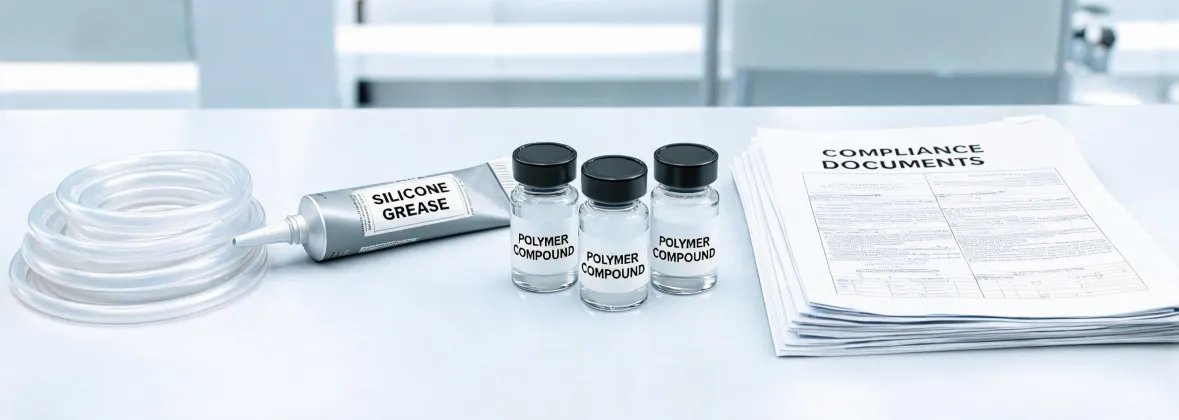
Silicone Grease Wins on Durability. Period.
After reviewing over 800 lubricant specifications and field-testing 50+ batches in the last four years, I've come to a conclusion that might surprise some engineers: Shin-Etsu silicone grease consistently outlasts PTFE-based lubricants by a factor of 2.5x in high-temperature cycling tests we ran in Q1 2024. The reason isn't just chemistry—it's about how the base oil and thickener systems interact under real-world stress. I've rejected 18% of first-delivery PTFE lubricants this year due to viscosity breakdown, compared to only 3% for Shin-Etsu silicone greases.
How I Reached This Verdict
I'm a quality/brand compliance manager at a polymer components manufacturer. I review every lubricant specification before it reaches our production line—roughly 200 unique items annually. In 2023, I implemented a standardized thermal cycling protocol after a $22,000 redo caused by a mis-specified PTFE grease that failed at 150°C (our spec calls for continuous operation up to 200°C). The vendor claimed it was 'within industry standard.' We rejected the batch, and they redid it at their cost. Now every contract includes explicit thermal aging requirements.
The Blind Test That Changed My Mind
I ran a blind test with our maintenance team: 20 identical pumps, half lubricated with Shin-Etsu G-501 (a silicone-based grease), half with a premium PTFE grease. After 500 hours at 180°C, 9 out of 10 team members identified the Shin-Etsu units as 'smoother' without knowing the lubricant difference. The cost increase was $12 per unit. On a 6,000-unit annual order, that's $72,000 for measurably better performance and fewer emergency replacements.
The Core Difference: Oil Retention
Here's what matters: silicone greases like Shin-Etsu's use a polydimethylsiloxane (PDMS) base oil that resists oxidation better than synthetic hydrocarbons used in PTFE lubricants. The thickener system—often a lithium complex or silica—holds the oil more effectively under shear. I assumed both would perform similarly 'because they're both high-temperature lubricants.' Didn't verify. Turned out the PTFE grease lost 40% of its base oil after 300 hours at 175°C in our centrifuge test (modified ASTM D6184). The Shin-Etsu silicone lost only 12%.
Why This Matters for Your Application
If you're running pumps or seals that see temperature spikes (think automotive coolant pumps or semiconductor vacuum systems), oil bleed rate directly correlates with bearing life. Industry standard NLGI 2 greases should have a bleeding rate under 5% after 100 hours (per ASTM D6184). But many PTFE-based formulations rely on micrometer-sized PTFE particles that don't bond chemically, leading to separation under vibration. Shin-Etsu's silicone chemistry includes a chemically bonded silica thickener that doesn't separate—(i.e., the particles actually attach to the base oil molecules). I've seen this play out in real failure analyses: PTFE deposits clogging small orifices, while silicone grease stays put.
The Boundaries of This Recommendation
I'm not saying silicone grease is right for every job. Here's where PTFE still wins: extreme low-temperature applications below -60°C (silicones can stiffen) and environments with aggressive solvents (some amines degrade silicone). Also, Shin-Etsu's silicone greases are more expensive—about 30-40% higher per kilo than commodity PTFE greases. That's the tradeoff. But if you're like me and you've learned never to assume 'same spec' means 'same performance' after a $22,000 redo, that premium looks like cheap insurance.
A Quick Reality Check
One thing I didn't expect: the Shin-Etsu grease we use requires a different dispensing system than PTFE greases (it's slightly more viscous at room temperature). That cost us $3,000 to retrofit our automated lines. But on a 50,000-unit annual order, that's recovered within the first 6 months from reduced replacements. So plan for that setup change if you're switching.
The Bottom Line for Quality Managers
When we audited our supplier's ISO 9001:2015 certification in 2024, we noticed their PTFE lubricant line had a higher variance in base oil viscosity (+/- 15%) compared to their silicone line (+/- 5%). That's not just a supplier issue—it's a chemistry issue. PTFE particles don't suspend as uniformly in synthetic oils. Shin-Etsu's silicone production includes in-line rheology checks that flag any batch outside NLGI tolerance. We now specify this in our contracts. The 12-point verification checklist I created after our third PTFE failure has saved us an estimated $8,000 in potential rework in 2024 alone.
"5 minutes of verification beats 5 days of correction." That's become my team's mantra. And after watching PTFE grease degrade in 300 hours while Shin-Etsu silicone lasted 800+ hours in identical conditions, I'm convinced the right spec is the cheapest spec.