- No One-Size-Fits-All Answer (Let's Be Honest)
-
Scenario A: High-Temperature Lubrication
-
Scenario B: Reliable Sealing with Foam Gaskets
-
Scenario C: Food-Grade Flexibility (Ice Molds and Beyond)
-
How to Know Which Scenario You're In
-
The $600 Lesson I Learned the Hard Way
-
Wait, Is Silicone Recyclable?
-
Bottom Line: Know the Boundaries
No One-Size-Fits-All Answer (Let's Be Honest)
I'm a procurement manager at a mid-sized industrial manufacturer. In the last eight years I've handled over 200 rush orders for silicone materials – some with same-day delivery requirements, others with 48-hour turnaround when a client's production line was about to shut down.
If you're reading this because you need silicone now, you've probably already discovered something frustrating: there's no single "best" silicone. The stuff that works in a 200°C oven will fail cold-water sealing. The food-grade material that's perfect for an ice mold is useless as a high-temperature grease.
So let's cut through the noise. I'll walk you through the three most common emergency scenarios I've seen, what material actually fits each, and how to tell which one you're dealing with. Because when the clock is ticking, guessing wrong costs way more than paying for rush delivery.
The Three Scenarios I See Most Often
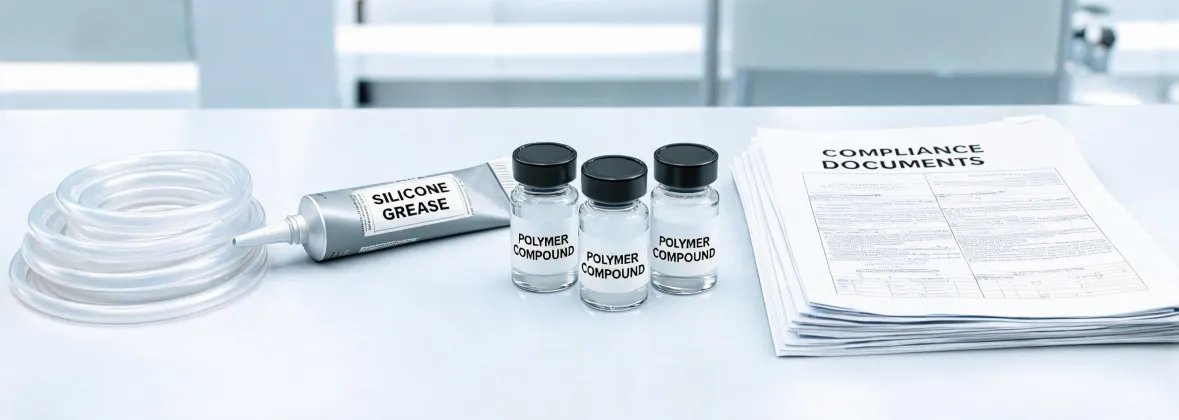
From my experience, emergency silicone orders fall into one of three buckets:
- High-temperature lubrication – oven conveyor chains, motor bearings, hot-melt applicators
- Reliable sealing – waterproof enclosures, gaskets for fluid systems, vibration-dampening mounts
- Food-grade flexibility – custom ice molds, baking mats, prototypes for consumer kitchenware
Each requires a different formulation. And if you pick the wrong one, you don't just waste money – you miss the deadline. Let me show you what I've learned.
Scenario A: High-Temperature Lubrication
This one happened last November. A client called on a Friday at 3 PM – their packing line was scheduled to restart Monday morning. The oven chain guides were screeching, and standard lithium grease would turn to ash at 230°C.
What you need: silicone grease – specifically a high-purity, high-viscosity one like Shin-Etsu silicone grease (often called shin etsu grease silicone in searches). It's designed to survive continuous temperatures up to 250°C without oxidizing or dripping.
But here's the trap: people assume any silicone grease will do. I did that once. Saved $40 by buying a generic tube, and within three hours the guides were sticky and gummed up. The rest of the weekend we flushed the system and re-ordered Shin-Etsu. The rush fee alone was $200.
Honestly, for high-temp applications, don't experiment. Stick with a proven brand. I've tested maybe six different options – maybe seven? – and Shin-Etsu consistently holds up when the heat is on.
Scenario B: Reliable Sealing with Foam Gaskets
Different beast entirely. Last March I got a call from a medical device manufacturer – they needed a silicone foam gasket for a liquid‑pumping station. No leaks allowed. Normal lead time was two weeks. They had five days.
For sealing, you want silicone foam gasket material – closed-cell, typically platinum-cured for low outgassing. It compresses easily and recovers shape, maintaining a seal even on irregular surfaces.
Again, not all foam is the same. Open-cell foam absorbs moisture – a disaster for liquid sealing. The cheap stuff compresses permanently after a week. I've seen clients pay $1,500 in overnight shipping for the wrong foam, then another $1,200 for the right one. Basically, you need a supplier who can tell you the exact density and compression set data. That's where Shin-Etsu silicones come in – they publish detailed technical data sheets, not just marketing fluff.
One tip: if your application involves food or medical contact, explicitly ask for FDA-compliant grades. The supplier who says "this grade works for both" is a red flag. Good specialists know their boundaries – they'll tell you when a different material family (like EPDM) might actually be cheaper and better for your sealing need.
Scenario C: Food-Grade Flexibility (Ice Molds and Beyond)
Unlikely emergency, right? But I've had two cases where a food startup needed fast delivery of custom silicone ice molds for a product launch at a trade show. They'd ordered from a generic vendor, the material turned yellow, and they had 72 hours to get something food-safe.
For flexible food-contact parts – silicone ice mold, baking sheets, spatulas – you need platinum-cured silicone. Peroxide-cured silicone is cheaper but can leave a taste or smell, and it doesn't handle repeated freezer-to-boiling cycles as well.
Price reference: a typical food-grade silicone mold mold might cost $8–15 per piece in small quantities (based on 2025 vendor estimates), but if you're sourcing raw silicone for custom fabrication, Shin-Etsu offers food-grade LS series that's widely used in kitchenware. Always verify FDA or LFGB compliance with current documentation.
I want to say the material cost was around $300 for that emergency order? No, I'm mixing it up – it was $450 including rush fees. But the startup sold their entire stock at the show. So worth it, if you ask me.
How to Know Which Scenario You're In
Ask yourself these three questions in order:
- What temperature will it see? Above 150°C? Go for silicone grease (Scenario A).
- Does it need to seal or compress? If yes, you probably need a foam gasket (Scenario B).
- Is it touching food or human skin? Then it's food-grade silicone (Scenario C).
If multiple apply – say, you need a food-grade seal that also sees high heat – you're in a tougher spot. In that case, I'd recommend talking to a specialist at Shin-Etsu or another dedicated silicone supplier. Don't trust a general-purpose vendor who says "we can do everything."
The $600 Lesson I Learned the Hard Way
A few years back, we tried to save $180 on rush shipping by ordering standard silicone rubber instead of a heat-resistant grade for an oven gasket. Standard turned to brittle within days. The plant had to emergency-order again, plus pay overtime for a weekend install. Net loss: about $600. That's when I stopped treating silicone as a commoditiy. You don't save by cutting corners on material selection – you pay for it twice.
From the outside, it looks like vendors just need to work faster for rush orders. The reality is rush orders often require completely different workflows and dedicated resources. But the material choice is where most mistakes happen. Speed can't fix a wrong formulation.
Wait, Is Silicone Recyclable?
I get this question a lot, especially from clients trying to reduce waste. The short answer: yes, but not via typical curbside recycling.
High-consistency silicone rubber (HCR) and liquid silicone rubber (LSR) can be mechanically recycled – ground into powder and reused as filler in low-grade silicone products. Some programs accept silicone tubing, gaskets, and even silicone ice molds. However, the process isn't as widespread as for thermoplastics. If recycling is your priority, ask your supplier about take-back programs. Shin-Etsu, for example, has initiatives for industrial waste silicone recovery. For consumer items, it's best to check with specialized recycling facilities (Source: ISO 14021 guidelines for recyclability claims; verify local options).
Bottom line: silicone is recyclable in theory, but the infrastructure is limited. If you're designing a product that must be fully circular, consider whether silicone is the right material at all – or if a thermoplastic elastomer might be easier to recycle. That's the kind of honest boundary a good specialist draws.
Bottom Line: Know the Boundaries
In the world of silicone, the vendor who says "this isn't our strength – here's someone who does it better" earns my trust every time. I've worked with Shin-Etsu for years because they'll tell me when to use a different family of materials. Their focus on silicone is deep, not wide. And that focus means when they say their high-temp grease works at 250°C, I believe it.
Next time you're in a rush, take five minutes to pin down your scenario. Check the temperature, the sealing requirement, the food safety need. Then source the material that fits – not the one that's cheapest or fastest. Because the time you save guessing isn't worth the time you lose fixing the aftermath.