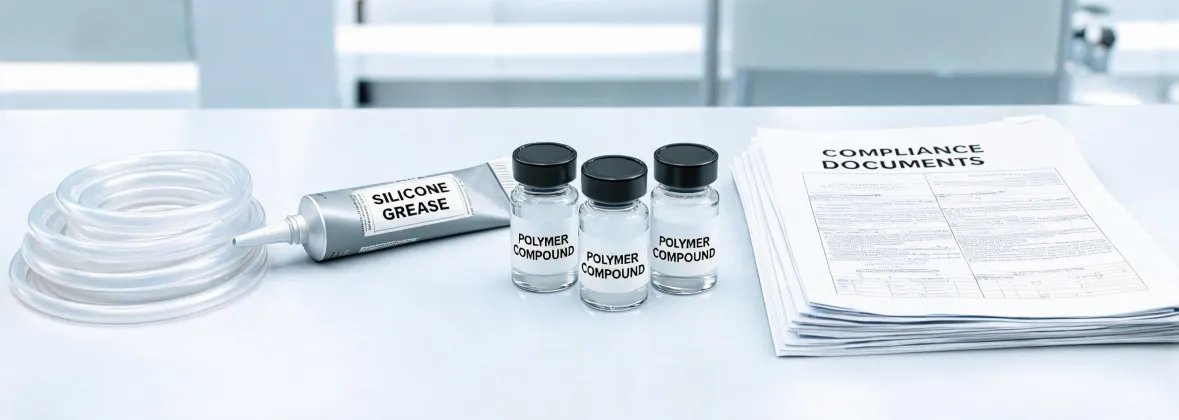
Take it from someone who has spent the last four years reviewing silicone and rubber products before they ship: small orders are not small risks. I'm a quality and brand compliance manager at Shin-Etsu, and I review roughly 200+ unique specs a year. In 2024, about 11% of first submissions were held for missing documentation or unclear spec alignment. That number doesn't change much when the order is small.
If you've ever been told that your quantity is too low to justify a custom spec, you know the frustration. But here's what I tell every customer: the spec matters more than the volume. Whether you're ordering silicone straps for a wearable or silicone dressings for a pilot medical trial, the material still has to meet the application. Let me explain why this matters.
Small Orders Often Come With the Strictest Requirements
In our Q1 2024 quality audit, the most interesting hold came from a customer buying fewer than 1,000 silicone dressings. Their intended use required ISO 10993-5 cytotoxicity screening and ISO 10993-10 irritation testing. The internal file didn't have the raw test report, only a summary sheet. The material may have been fine, but the evidence wasn't traceable. We held the batch, dug out the raw data, and shipped a few days late. The lesson: compliance is about proof, not intention.
That was the moment I stopped thinking of small orders as 'easier' work. We didn't have a formal verification protocol for small-lot custom compounds until that audit. The third time I saw a missing batch number on a small order, I created a verification checklist that requires material traceability regardless of order size. Should have done it after the first time.
And here's the surprise: the small customer caught the gap before we did. They asked why the test report referenced a different batch number. It was a detail our internal review missed. Small customers can't absorb bad batches, so they tend to read the paperwork more carefully. That habit makes everyone better.
Take silicone straps as another example. They're used in wearables, watchbands, and industrial bands that sit against skin or harsh environments. A short production run doesn't change the fact that the strap needs UV stability, tear strength, and mold-release performance. If a strap cracks after three weeks of sun exposure, it doesn't matter whether the batch size was 50 or 50,000—the user experience is ruined.
For silicone dressings, the same principle applies. They may need breathability, skin adhesion, and controlled peel strength. Those properties are set by formulation and curing, not by batch size. A pilot batch that skips validation can produce misleading results when you scale up.
Shin-Etsu Grease vs Silicone Grease: The Real Lesson
One comparison I see a lot is shin etsu grease vs silicone grease. People often ask me about honda shin-etsu silicone grease reviews, especially for door seals and weatherstripping. The useful reviews are the ones that mention temperature extremes, repeated use, and the exact part being lubed. Not just 'it stopped the squeak.'
Grease selection is a compatibility test, not a popularity test. A general-purpose silicone grease might be fine for one sealing job and completely wrong for another. It can swell or soften certain elastomers if the formulation isn't matched to the substrate. The surprise wasn't the price difference between the two greases. It was how many buyers chose based on a generic data sheet without checking compatibility with their actual parts. In one review, we tested a customer's rubber gasket against a general-purpose grease and a more carefully formulated product. The formulation changed the result. The order size didn't.
I know 'silicone grease' sounds like one category. But in practice, the difference between a grease that protects and one that damages can come down to the solvent system or the filler type. That's why review snippets are only useful as a starting point.
If you're buying grease, ask about base oil, thickener, temperature range, and plastic compatibility. Apply the same logic to any silicone material: the data sheet is the beginning of the conversation, not the end of it.
Silicone vs Rubber O-Rings: It's About Failure Mode
Another frequent question is silicone vs rubber o-ring—which is better? The honest answer: it depends on the failure mode you're designing against.
Silicone o-rings offer a wider temperature range and are often better for static seals in high-heat environments. But silicone has lower tear strength and abrasion resistance than many rubber compounds. For dynamic or high-pressure seals, nitrile or EPDM o-rings are often the better engineering choice. That's not an opinion. It's a material property you can verify using ASTM D2000 classifications.
Small customers tend to ask better questions here because they don't have the safety net of a huge inventory buffer. They ask about compression set at 150°C, UL recognition, or hardness durometer. Those questions force both sides to be precise. As of January 2025, the most common gap I still find in pre-shipment reviews is missing batch traceability, not missing material certificates.
What I Actually Check on Every Silicone Order
Here's what I look at on every spec, no matter the quantity:
- Batch traceability: Can I trace the compound back to the original cure date and raw material lot?
- Spec alignment: Does the test report match the agreed standard, not a 'similar' one?
- Application context: Is the test temperature, media, and mechanical load representative of real use?
That list doesn't change for small batches. If anything, it matters more, because a failed sample run can give you misleading data to build a mass production spec on.
'Small Orders Cost More' Is Not an Excuse
Let's address the elephant in the room. Small-batch orders do cost more per unit. Tooling, changeover, testing, and documentation are fixed costs that don't disappear just because the volume is low. I'm not going to pretend otherwise.
But cost per unit is not the same as cost of quality. If you're buying 1,000 silicone straps and the supplier sends you a 'standard' compound with no batch traceability, the invoice might look good. The first field failure will erase that savings. I've seen a $2,000 savings on a small order turn into an $18,000 redo because the material couldn't pass the customer's own validation test.
So yes, small orders can be more expensive per piece. That doesn't mean they're worth less attention. It means the supplier should be honest about setup costs and clear about what's included in the price. A quality inspector who treats small orders as 'not worth the effort' will eventually make the same mistake on a large order, because the habit becomes routine.
Hold the Standard, Not the Order Size
So here's my position, and I'm not going to soften it: today's small customer deserves the same spec alignment, testing, and traceability as tomorrow's large one.
I'm not saying every small batch needs a full qualification program. A silicone o-ring in a water pump and a silicone strap on a wearable have different risk profiles. The key is matching the testing to the application, not to the order size. But if failure would hurt, the quantity on the line shouldn't change your risk tolerance.
If you've ever been made to feel like a small order is a nuisance, hold your ground. Ask for the test data, the batch number, the standard. Suppliers who respond with respect are the ones who should get the follow-up order.
The next time someone asks if you really need that certificate for a small run, remember: the question itself is a test. The right supplier will walk you through the options, tell you what is required for your application, and let you decide. The wrong one will make you feel like the request is an inconvenience.
Trust me on this one. The quantity changes the price per piece, but it doesn't change the physical properties of the material. And it definitely shouldn't change how seriously we take your requirements.