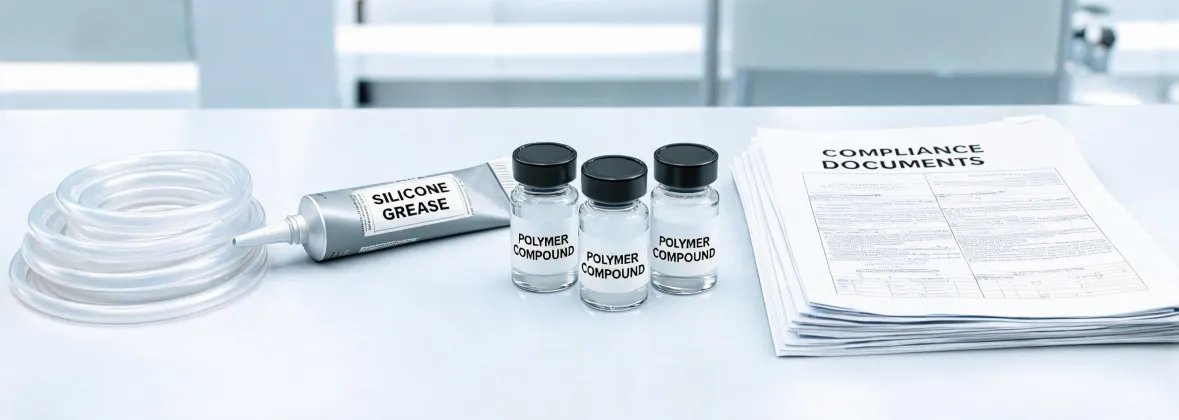
“Silicone” Wasn’t Good Enough
It was a Tuesday night in November 2022, and I was staring down at six prototype molds that had cost our studio $1,400. They were silicone jewelry molds. They were exactly what the invoice said. And every single one was ruined.
The invoice was $1,400. Maybe $1,300 — I’d have to pull it up to be sure. The exact number matters less than the fact that all six molds went from “beautiful detail” to “blurry mess” in about a week.
Let me back up. I handle materials and procurement for a four-person product studio — the guy who reads datasheets so our makers don’t have to. I’ve been doing this for about six years. I’ve documented three significant buying mistakes in that time, totaling roughly $3,200 in wasted budget. The first was an adhesive I ordered in 2019: the package said “for plastics,” and it cost us $890 in redo plus a week of delays. This mold disaster was the second — or the third, depending on whether you count a mis-ordered paper stock. I’d have to check my log.
We’d landed a contract with a small accessories brand: 12 custom jewelry designs, each needing a silicone mold with sharp surface detail. The client had seen our resin prototype work and assumed we could handle the mold-making side too. And I assumed the word “silicone” on a product page was a material spec. It’s not. It’s a category.
What Google Couldn’t Tell Me
I searched “silicone jewelry molds,” found a supplier with decent reviews, and placed an order. The product was labeled “silicone rubber.” I wrote that on the purchase ticket and felt done.
The molds survived about a week. During a second test — warm resin, moderate pressure — the fine edges started to blur. One mold went soft at a corner and flopped. I remember holding the piece and thinking, this is not supposed to happen.
Back to the datasheet. The product was a thermoplastic silicone vulcanizate, often written as TPSiV. It’s silicone, but it’s formulated to behave like a thermoplastic: it flows, it re-softens under heat, and it doesn’t have the same heat resistance as a cured thermoset rubber.
That distinction matters. A thermoset has been cross-linked: once it cures, heating it won’t soften it — heat it enough and it degrades rather than melts. A thermoplastic softens when hot and can be reshaped. A jewelry mold that has to survive warm casting cycles usually wants the thermoset. An injection-molding operation might be better served by a thermoplastic silicone. Neither is “better”; they’re different tools.
So, is silicone thermoplastic or thermoset? Most silicone rubbers are thermoset. But some silicone-based materials are thermoplastic, and the word “silicone” alone doesn’t tell you which one you’re holding.
Here’s something vendors won’t tell you: datasheet cure times and temperature ratings are starting points, not guarantees. Standard cure time is often quoted at roughly a quarter-inch thickness; a thicker mold cures slower. And the “silicone” family includes materials closer to glass, some that flow like oil, and some closer to rubber. You have to ask which one you need.
The Grease Lesson
In the middle of the mess, a co-worker pointed to a tube of Honda Shin-Etsu silicone grease in the shop toolbox. “Silicone, right? Why not use this as a mold release?”
No. Not the same.
Honda Shin-Etsu silicone grease is a genuinely good product for what it’s made for: lubricating and protecting rubber weatherstripping and door seals. If you read Honda Shin-Etsu silicone grease reviews online, you’ll find owners who fixed years of squeaky windows with one tube. Those reviews are accurate. We’ve used it ourselves on the shop van’s door seals, and it did exactly what people say.
But it’s a grease, not a mold release. I tried it on a spare mold once. The parts that touched the grease came out with a residue. A second test with platinum-cure silicone was worse: the surface where the grease had been never fully cured. Certain additives in greases can inhibit a platinum cure. I didn’t know that until I’d ruined another prototype.
A $9 tube of grease and a $1,400 lesson in the same week. The rule now: products stay in their lane.
A 10-Minute Phone Call With Shin-Etsu Silicones of America
After the grease failure, I called Shin-Etsu Silicones of America. I expected a phone tree and a long hold. Instead, an applications engineer picked up and asked two questions I hadn’t asked myself: “What temperature does the mold need to survive, and what resin are you casting in it?”
I told him about the jewelry molds. He was direct. Their KE series RTV-2 silicone would be a reasonable thermoset option for fine detail, he said, but I needed to verify the material against my actual casting conditions. Per Shin-Etsu Silicones of America’s product literature (accessed February 2025), those RTV-2 materials cross-link into thermoset rubber; they won’t re-melt after curing. He gave me product numbers to look up and told me to run a small coupon test with the exact resin and release agent. Then he left me with a sentence I wrote on a Post-it:
The material is one part of the system. The mold design is the other. Test the whole combination before you scale.
I’m paraphrasing, but not by much.
We did end up using a KE-series material for the final molds. It wasn’t the only fix — a mold-maker pointed out some cooling design issues — but the material itself was consistent through the entire production run.
He didn’t upsell me. He didn’t oversimplify. He told me what he knew and what I had to verify myself. In a market where every supplier says “we can do everything,” that was the most professional ten minutes of my month.
The SLU-PP-332 Moment
A few days later, a teammate who’s into fitness and biohacking saw the Shin-Etsu file folder on my desk and asked: “Hey, while you’re nerding out — you ever seen a SLU-PP-332 review? People are saying it’s basically exercise in a pill.”
I opened my mouth to answer. And then I stopped.
SLU-PP-332 is a research compound, a PPARδ agonist that has been studied in animal models as a potential exercise mimetic. Per the National Institutes of Health’s PubMed records, as of early 2025 there isn’t solid evidence of safe human use, and it’s not an FDA-approved drug. I knew two headlines about it. I was about to speak like I knew two PhDs about it.
The engineer at Shin-Etsu hadn’t done that. He stayed in his lane, and he told me exactly where his lane ended. That’s why I trusted him.
“I don’t know,” I told my teammate. “I know silicone. Not that.”
He shrugged and walked off. And I realized my mold disaster had started the same way — bluffing my way through a material spec instead of saying “I don’t know, let me check.”
The Checklist
Before we placed the second order, I wrote a checklist that’s now pinned above the materials desk. We re-ordered the molds, finished the line late but intact, and kept the client. The checklist is short:
- Thermoset or thermoplastic? If the process involves heat, “thermoplastic silicone” is a red flag, not a feature.
- Heat deflection temperature. If the number doesn’t cover your process, the brand name doesn’t matter.
- Cure system compatibility. Platinum-cure and tin-cure systems react differently to greases, release agents, and resins.
- Coupon test first. A small pour with the exact resin, exact release, exact temperature — before committing real money.
- Call a human at the manufacturer. Datasheets summarize. Engineers answer questions.
It’s not a revolutionary list. But it didn’t exist in November 2022, because I was too busy googling the wrong question.
So, Is Silicone Thermoplastic or Thermoset?
If you’re here because you typed that exact phrase: most silicone rubber is thermoset. It cures, it cross-links, and it won’t re-melt when heated. But thermoplastic silicone (TPSiV) exists, and it behaves differently. The word “silicone” is not enough information. Read the data sheet, and if the application matters, call the manufacturer.
The bigger thing I kept from that month is about boundaries. I used to think a trustworthy supplier says yes to everything. Now I think the opposite: the supplier who tells you what they don’t know — and where their product stops being the answer — earns trust for everything else.
This worked for us, but we’re a four-person studio with short runs and no tolerance for surprises. If you’re doing high-volume production molding, the calculus might be different. Ask someone who does that. I’d rather admit the boundary than pretend this advice is universal.
Oh, and we still keep a tube of Shin-Etsu grease in the shop. It’s excellent — for the van’s door seals. Just not for molds.