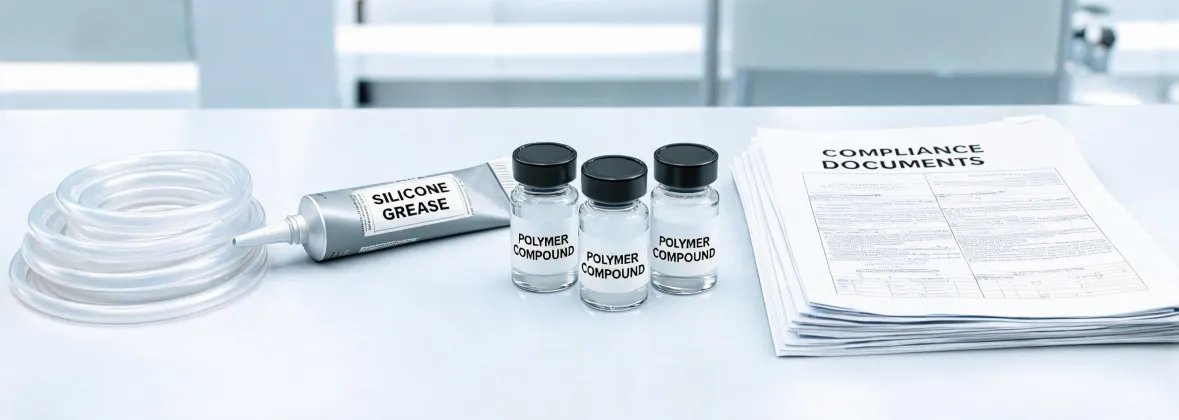
In September 2022, I sat in our conference room and watched a two-second video. The clip showed a quality technician bending a silicone sleeve in a cold chamber at -40°C. A real silicone sleeve should flex at that temperature. This one snapped clean in half, like a stale breadstick. I didn't need to see the rejection report. I already knew which order it came from.
I have been a materials buyer at a custom rubber and plastics manufacturer since March 2017. We make silicone sleeves for wire-harness protection, sealing boots, grommets, and molded seals, plus plastic parts in nylon, PBT, and polycarbonate. The work is not glamorous, but it has to survive under a hood or inside a control cabinet. And I have personally made (and documented) 14 significant sourcing mistakes over eight years. Roughly $46,000 of wasted budget. Two of the worst mistakes were silicone-related.
The Grease Bargain That Wasn't
My first silicone mistake was not the dramatic one. In February 2019, our assembly area used a silicone grease in an automated dispenser. The applicator deposited a thin layer of grease onto silicone seals before assembly, and the equipment manufacturer specified a soft grease with an NLGI 0 consistency. I saw a cheaper alternative online with 'silicone grease' on the page and ordered eight cartridges. The purchase saved around $120.
People think silicone grease is one product. It is not. The label tells you the family; the data sheet tells you whether the product can do the job. The cartridges that arrived were a common NLGI 2 general-purpose grease. Fine for greasing a bearing by hand, not fine for pumping through a narrow feed line at plant temperature. The dispenser started skipping around midday. By the time the line supervisor called me, we had several hundred components with no way to tell which ones had received enough lubricant and which ones had not.
We stopped the line, cleaned the applicator, manually re-lubricated what we could, and scrapped the questionable parts. The $120 we saved became roughly $2,700 in labor, lost production, and cleaning solvent. Maintenance still brings it up (I still hear about that one. I deserve it). The NLGI grade numbers come from a standardized cone penetration test, ASTM D217. They are not marketing terms. What is right for a hand-packed bearing can be completely wrong for an automated dispenser.
The Silicone Sleeve That Cracked at -40 Degrees
In late summer 2022, we won a 30,000-piece order for protective silicone sleeves used by a truck wiring-harness assembler. Our own line had no spare capacity, so we subcontracted part of the volume. The subcontractor's quote was about 18% below the next bidder. Their sample sleeves passed our bench checks. The paperwork included a material statement that looked fine. We wrote the purchase order, paid the deposit, and waited.
Delivery arrived in September. The cartons were labeled correctly, and incoming quality checked length, hardness, and color. All passed. We did not run a cold-flex test because the data sheet promised a low-temperature limit far below our requirement. But that data sheet was not tied to a specific production lot. That oversight cost us.
The customer's incoming inspection ran its own cold-flex check. Twelve of the first twenty sleeves cracked. The whole lot was rejected. At first, the subcontractor blamed handling, storage, and anything else. They could not provide a production lot test report because none had been done. The low-temperature testing had only been performed during the original material qualification, and the qualification sample was not the same lot.
The purchase order said 'low temperature flexible to -40°C.' It did not define a test method. It did not require a lot-specific certificate. It did not give us the right to pull samples. Those missing details were the real defect. I am not a chemist, so I cannot explain exactly why the delivered compound became brittle. What I can tell you from a buyer's perspective is that the retained samples failed testing. The vendor's certificate was a statement of intention, not evidence. That distinction is the whole problem.
The rejected lot was 12,000 pieces. Replacement forced us to pay expedite freight and still put the schedule three weeks behind. One customer meeting opened with the phrase 'we need to understand what changed.' We could not answer, not because we were hiding anything, but because the data was not there.
People sometimes assume that suppliers with full traceability charge more because of their brand name. My experience points the other way: traceable material costs more to produce and sell because testing and documentation are real expenses. Cut that line item today, and the bill arrives later with freight charges attached.
Why Traceability Now Comes First
After that rejection, our quality manager and I rebuilt the supplier approval process. During that rebuild, I also looked more carefully at how the Shin-Etsu Silicones Company publishes its technical data. The material data sheets name the product, list the standard, and represent the manufacturer's actual published information. If our engineers type 'Shin Etsu' without the hyphen, they still find that original documentation.
That documentation culture matters. When we now buy silicone grease for the dispenser or silicone sleeve material for a customer order, the quote has to reference manufacturer data and lot traceability. If a supplier tells me a material is 'basically the same as Shin-Etsu,' what I hear is: they cannot prove what they are selling. Maybe it is fine. Maybe not. I no longer gamble on maybe.
The Same Checklist Applies to Thermoplastic Resin Distributors
Our plant does not only buy silicone. We also mold parts from engineering thermoplastic resins, and that supply chain carries the same risk. A colleague asked me recently what the best thermoplastic resin distributors do differently from the ones that cause problems. My answer was the same list I use for silicone grease and silicone sleeve materials.
- They name the original manufacturer on the quote. For us, a distributor with an authorized relationship is a different risk level from a broker who buys surplus material and resells it without traceability.
- They provide data sheets and test reports from the original manufacturer, not a rewritten summary from a sales desk.
- They issue lot-specific certificates of analysis. The certificate has to match the lot numbers on the physical material, not just the product name.
- They don't answer 'what changed in this lot?' with 'it should be fine.'
For us, the best thermoplastic resin distributors have the same habits as the best silicone material suppliers: they treat documentation as part of the product, not as an afterthought.
What I Check Before Every Order Now
Since we formalized this list in June 2024, it has caught eleven potential mismatches before production. Eleven. That is what traceability gives you: the chance to catch a problem while it is still a spreadsheet entry, not while it is sitting in a customer's cold chamber.
Our quality manager summarized it best after the September rejection: 'The most expensive silicone is the one you buy twice.'
I have not forgotten that. Every quote I approve now comes with the same question: show me the test data for this lot. If you cannot, there is no price advantage. There is only deferred risk.