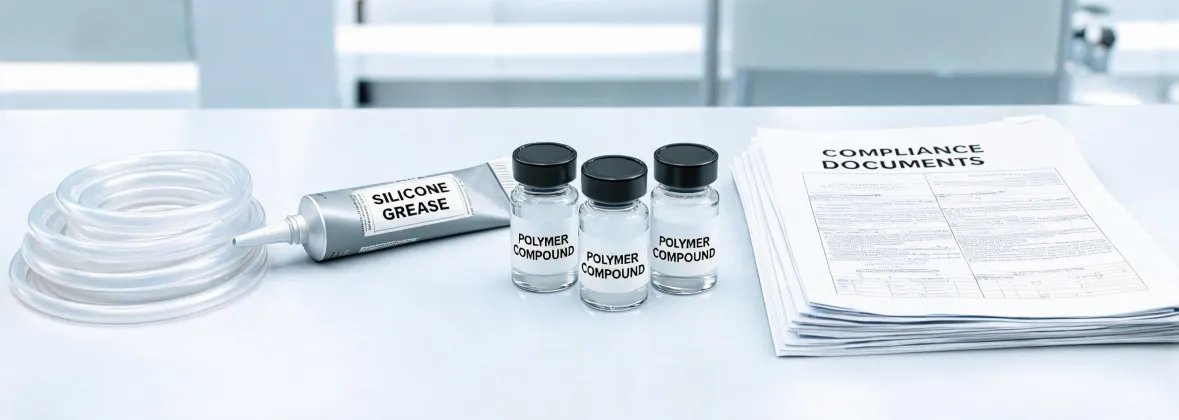
I'm not a chemist, so let's get that out of the way first. I'm the office administrator who manages purchasing for a 200-person manufacturer. I process roughly 60-80 orders a year for MRO supplies, raw material samples, and production trial materials, and I report to both operations and finance.
That gives me an odd perspective on the phrase silicone material. I only see it after an engineer has specified it. The word silicone shows up on a grease tube for weather seals, on a liquid silicone rubber spec sheet for molded kitchenware, and on a high-performance elastomer datasheet for an industrial part. They are all silicones, but they are not the same conversation.
If you searched shin etsu grease vs silicone grease, or if you are comparing thermoset vs thermoplastic polymers for a part you plan to make, you are actually in one of three purchasing situations. It helps to know which one before you evaluate price.
There Is No Single Best Silicone Choice
The reason you won't find one clean answer is that silicone is an umbrella, not a specification. A grease, a rubber part, and a production raw material all require different decision rules.
- Scenario A: Maintenance and repair. You need a lubricant or seal treatment, and you are deciding between a named product like Shin-Etsu grease and a cheaper product labeled silicone grease.
- Scenario B: Product manufacturing. You are selecting a polymer for an actual component, such as a food-contact silicone ladle, gasket, or overmolded handle. Here the thermoset vs thermoplastic tradeoff matters.
- Scenario C: Production sourcing. You are no longer buying a tube here and there. You need a qualified supply chain and you are dealing with a company like Shin-Etsu Silicones Company through its distribution network.
Each scenario has a different answer. That's not a dodge. It's how an experienced buyer avoids ordering the wrong thing three times.
Scenario A: Maintenance Grease
This is the section you want if you typed shin etsu grease vs silicone grease.
Here is what I have learned after five years of placing these orders. Silicone grease is the broad category. Shin-Etsu grease, as we buy it, is usually a specific formulation that an equipment manufacturer selected and put its part number on. That matters because the formulation was likely chosen for low volatility, rubber compatibility, and a wide service temperature range. When a service manual says use Shin-Etsu grease, the designation is not a brand suggestion. It is a material selection.
The generic product may work in non-critical situations. But from a purchasing perspective, I am not the one who should make that call. If the application is controlled by a maintenance procedure or an OEM specification, I buy to that spec. If the application is casual and no one has specified a product, a general silicone grease can be acceptable. At least, that has been my experience with our own maintenance team.
So glad I checked the part numbers in 2022. I almost ordered twelve discounted tubes of silicone grease to save us a little over two hundred dollars. The senior maintenance tech caught the mismatch before I clicked submit. We would have saved money on the tubes and spent more on rework and explanations later.
My rule for Scenario A is simple: compare part numbers and supporting documents, not just the words silicone grease on the label. If a supplier cannot provide a technical data sheet and a safety data sheet for the exact product, we do not put it on a maintenance cart.
Scenario B: Thermoset vs Thermoplastic Polymers in Manufacturing
This gets into polymer chemistry territory, which is not my expertise. What I can tell you as a buyer is how the decision shows up in purchase requests.
When engineers compare thermoset vs thermoplastic polymers, they are really comparing two families of behavior. A thermoplastic softens when heated and hardens when cooled. It can be reshaped and reprocessed in principle. Nylon, polypropylene, and many TPEs are thermoplastics. A thermoset, by contrast, undergoes an irreversible curing reaction. Once it is crosslinked, it will not melt again. Silicone rubber is usually in this family, both as liquid silicone rubber and as high-consistency rubber.
Silicone is not automatically the premium choice, and this is where popular intuition can mislead a purchasing team. Take a kitchen tool like a silicone ladle. A designer might compare a thermoset liquid silicone rubber against a thermoplastic elastomer. The TPE can be molded in a faster cycle and produces scrap that is easier to reuse. But if the ladle has to survive hot food, boiling water, dishwasher heat, and long-term flexibility, thermoset silicone often wins because it holds its properties better at temperature and does not melt or permanently deform.
At the same time, if a product never sees high heat, thermoplastic can be the more efficient call. The mistake I see in request forms is silicone being chosen because it sounds like a premium material rather than because the application requires its properties. That said, when a product truly needs heat resistance, chemical resistance, or long-term flex, silicone is hard to beat. Neither family wins in the abstract. The application decides.
From a documentation standpoint, I also look for compliance evidence. The phrase food-grade silicone is not a legal definition. In the US, repeated-use food-contact rubber articles are commonly evaluated against FDA 21 CFR 177.2600. In Europe, material certificates often reference BfR Recommendation XV for silicones. I'm not a regulatory expert, so I do not interpret those documents. But I do insist that the material supplier provides them. If a vendor responds with vague marketing language instead of a batch-specific declaration, we treat that as a red flag.
Scenario C: Sourcing Production Volumes from Shin-Etsu Silicones Company
Once you move from sample orders to production volumes, the buying process changes completely. You are no longer picking a grease off a shelf. You are building a qualified supply chain.
I don't have hard data on the share of grey-market silicone products sold through online marketplaces. What I can say anecdotally is that in our industry, traceability problems cause more damage than unit price differences. A material that arrives without a clear lot number, a usable certificate, and a proper commercial invoice is not actually cheaper.
If your engineering team names a specific silicone manufacturer, the responsible move is to buy through an authorized channel. For Shin-Etsu Silicones Company, that generally means working with regional subsidiaries or their authorized distributors rather than treating the corporate site like an ordinary web shop. We verify that a distributor can provide lot traceability and current documentation before we add them to our approved vendor list.
One invoicing lesson still sticks with me. In 2024, I approved a small purchase order for a material that looked identical to our usual product but came from a reseller with a lower price. The vendor could not issue a proper commercial invoice. Finance rejected the expense report, and I had to absorb the cost from the department budget. It was a few thousand dollars, but the real damage was the lost time and the awkward conversation with my manager. Now I verify invoicing capability and document flow before any new vendor receives an order. Dodged a bullet when our quality team caught that reseller's lot certificate mismatch a month later.
For production quantities, I ask for the complete package: material grade, batch number, country of origin, safety data sheet, technical data sheet, and any applicable food-contact or industrial compliance certificates. After we moved these requirements to a structured checklist in 2024, our new-vendor review time dropped from about five days to two days. That is not glamorous, but in purchasing, faster verification is a competitive advantage.
Which Scenario Is Yours?
If you are choosing a grease for maintenance, assembly, or repair, you are in Scenario A. Match the exact part number and require the supporting documentation. If the grease is not specified, a general silicone grease can work, but do not use it where an OEM has already made a material decision.
If you are choosing a material for a manufactured product, you are in Scenario B. Define what the product has to survive: heat, cold, chemicals, food contact, repeated flexing. Then let the requirements determine whether thermoset silicone is justified or whether a thermoplastic is the more efficient answer.
If you are sourcing production volumes and the specification already says silicone, you are in Scenario C. The engineering decision has been made. Your job is to verify the supply chain, confirm lot traceability, and make sure every delivery arrives with documents that your quality team and finance team can actually use.
No one wants to buy the wrong silicone material twice. The right question is not which product name wins. The right question is which level of rigor your application requires. Once you know that, the product choice becomes easier than the search results suggest.