-
Shin-Etsu Silicone FAQ: Answers When the Clock Is Running
-
Is Shin-Etsu silicone grease the same as any silicone grease?
-
Do silicone foam strips work as gaskets in an emergency?
-
What is a silicone mattress?
-
Silicone vs acrylic roof coating: which is cheaper?
-
How do I spec silicone without time for lab testing?
-
What is the fastest way to confirm a replacement silicone fits?
Shin-Etsu Silicone FAQ: Answers When the Clock Is Running
In my role arranging silicone material supply for OEMs and contractors, the phones are not polite. A customer needs a replacement gasket tomorrow, a roof coating before the fall rains, a grease that won't make the seal swell by the end of the week. I've helped source over 200 rush orders in the last five years, and the questions are remarkably consistent.
This FAQ is the short version of what I tell those callers. If you're searching for Shin-Etsu silicone, need a silicone foam strip that matches a failed part in 48 hours, or are comparing silicone and acrylic roof coatings, these are the answers I reach for.
What we'll cover:
- Is Shin-Etsu silicone grease the same as any silicone grease?
- Do silicone foam strips work as gaskets in an emergency?
- What is a silicone mattress?
- Silicone vs acrylic roof coating: which is cheaper?
- How do I spec silicone without time for lab testing?
- What is the fastest way to confirm a replacement silicone fits?
Is Shin-Etsu silicone grease the same as any silicone grease?
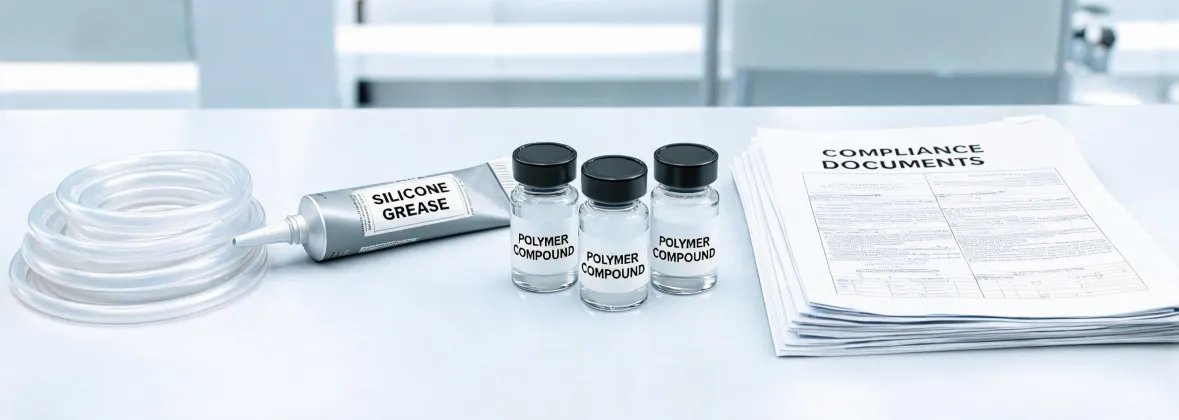
Not exactly. 'Shin-Etsu grease' is a specific class of silicone grease, not a generic silicone lubricant. The search term 'shin etsu grease silicone' often comes from people trying to match an OEM part number for door seals, window channels, or weatherstripping. That's not arbitrary: the grease's base oil viscosity and thickener chemistry are selected so it won't swell or degrade EPDM rubber the way some general-purpose rubber greases can.
In March 2024, a maintenance engineer called about a sticky window channel in a fleet vehicle. Day one, they grabbed a general-purpose grease from a local auto parts store. Day two, the seal swelled and the window stopped moving. The replacement trim kit cost $1,400. The correct Shin-Etsu grease would have been about $25 delivered.
If your service manual says 'Shin-Etsu,' that's a compatibility call. Match the part number before you match the color of the tube.
Do silicone foam strips work as gaskets in an emergency?
Silicone foam strips can be a legitimate emergency gasket, but only if you respect the compression spec.
Closed-cell silicone foam is different from sponge rubber or solid silicone. It seals gaps with low clamping force, handles temperature extremes, and resists UV. But it doesn't bounce back forever. If you compress it past its designed deflection, it takes a set and the 'spring' is gone.
For static access panels and electrical housings, a silicone foam strip is a defensible quick fix. I've done it when the original die-cut gasket had a three-week lead time. The failures I've tracked all came from the same mistake: over-compressing the foam. The datasheet lists compression deflection at 25% or 50%; use that number, not your torque wrench.
(Should mention: closed-cell silicone foam strips are not for hot oil or concentrated solvents. If your leak involves hydrocarbons, call before you cut.)
In 2023, a filter housing manufacturer needed 200 meters of foam strip in 36 hours. Normal lead time was ten days. We shipped 3 mm closed-cell silicone foam with acrylic adhesive from stock. It passed their 14 kPa air test. But that only worked because they knew the gap tolerance and the foam's compression range before they called.
What is a silicone mattress?
Honestly, I'm not sure why 'silicone mattress' has so many different meanings. My best guess is that different industries use the same words for different products. In my experience, it means one of three things:
- A mattress fabric coated or laminated with silicone for stain and water resistance
- A foam core made with silicone-based additives that change cell structure or feel
- A silicone rubber mat or pad for industrial or medical positioning
If you're buying components for a medical or residential mattress, the first question isn't 'is it silicone' but 'what is the silicone doing?' Coating, foam additive, or solid sheet? That changes the spec completely.
A buyer once asked me for a 'silicone mattress' to ship in 24 hours. After two clarifying questions, we found out they needed a silicone-coated fabric for a pressure redistribution pad—not a mattress, not a foam, not a sheet of solid silicone. We got the fabric the next morning. If we had guessed from the search term alone, we'd have sent the wrong product.
If you're stuck with the same vague description, ask for a drawing or the existing part number. Silicone isn't a material spec; it's a family of materials.
Silicone vs acrylic roof coating: which is cheaper?
Acrylic is cheaper per gallon. Silicone is generally cheaper per year. That's the total-cost answer, and it matters more than any price list.
From contractor quotes I reviewed in Q3 2024, acrylic roof coating landed around $1.50–$2.00 per square foot applied, and silicone around $2.50–$3.50. Prices move with silicone monomer and acrylic resin markets, so verify current numbers. But the difference in service life and failure mode is where the real economics live.
Acrylic is a fine coating on dry, sloped roofs where you can control moisture and plan a 3- to 5-year maintenance cycle. It's not ideal for ponding water or cold-weather application; it's water-based, it can re-emulsify, and UV exposure accelerates chalking and embrittlement. Silicone cures into a seamless rubber membrane, handles standing water, doesn't re-emulsify, and reflects heat if you choose a white grade.
In 2019, a commercial building owner in the Pacific Northwest paid for an acrylic coating on a flat roof. It failed in the fourth year with pooled water. In 2023, they specified silicone. As of Q4 2024, no leaks, no peeling, no maintenance. That doesn't mean acrylic is 'bad'—to be fair, it's the right low-first-cost tool for many projects. But 'which is cheaper' is the wrong question. Ask 'which has the lower cost over the intended service life?'
How do I spec silicone without time for lab testing?
Use a decision order based on the environment, not the brand or product family. Starting with 'I need silicone' is like starting with 'I need metal.'
If you have two hours before a purchase order cutoff, get these four data points:
- Maximum continuous temperature and the short-term peak temperature
- What the material touches: air, water, oil, solvent, UV, ozone
- Mechanical requirement: compression, deflection, movement, or hardness
- Any flammability or certification requirement: UL, FDA, automotive, medical
Then compare silicone products on those specs. For grease, you care about base oil viscosity and rubber compatibility. For foam strips, compression deflection and density. For roof coating, cured film thickness and elongation.
My rule after more than 200 rush orders: never order silicone by the color of the tube or the smoothness of the datasheet. Ask for the technical data sheet and the safety data sheet. If the supplier can't produce both within four hours, that's a warning sign. I learned that in 2021 when a vendor promised a 'high-heat silicone grease' that turned out to have a peak rating below the application's operating temperature. We caught it from the data sheet, not the label.
What is the fastest way to confirm a replacement silicone fits?
Measure the gap, not the old gasket. That is the fastest and least obvious step.
Old foam strips compress, swell, and take a set. If you order a replacement based on the worn part's width, you can end up with a strip that's too thin or too wide. Use calipers on the actual gap between the mating surfaces.
In 2022, a medical equipment maker called at 3 PM for a self-adhesive silicone foam strip for a console door that had to ship at 7 AM. Normal lead was five days. They sent a photo of the extruded aluminum profile and the caliper measurement of the gap: 4.1 mm at the latch side, 4.4 mm near the hinge. We matched a 4 mm closed-cell silicone foam strip with acrylic adhesive. The door sealed on the first try.
The same logic applies to grease and roof coating. If you're replacing a specified 'Shin-Etsu grease,' search the exact part number, not the phrase 'shin etsu grease silicone.' The part number maps to a specific base oil viscosity and thickener. If an old roof coating is failing, check the previous coating chemistry before you topcoat; silicone over acrylic can cure fine only if the acrylic is fully dry and sound, and acrylic over silicone will usually not adhere. That compatibility check is a 15-minute phone call that can save a $30,000 redo.