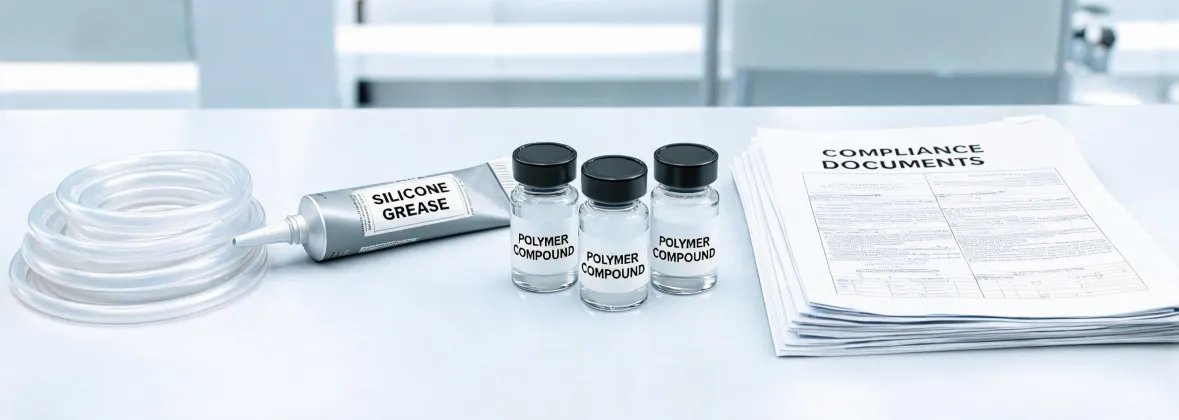
I manage procurement for a medium-sized manufacturer — we run around 200 product SKUs, and our annual material spend is roughly $1.8M. Over the past 7 years tracking every invoice and testing hundreds of material samples, I’ve learned one thing for sure: there’s no single “best” material for sealing or thermal management. It depends entirely on your application. But buyers keep asking me the same question: “Should I use Shin-Etsu silicone grease or a PTFE-based alternative?” Or worse: “Our engineer specified a polymer coating — do we need Teflon?”
Here’s the thing: the answer changes based on temperature, pressure, cycle life, and — most importantly — your cost model. I'll walk through three common manufacturing scenarios and show you how the total cost of ownership (TCO) plays out for each. This isn’t a spec sheet comparison; it’s a real-world procurement breakdown.
Scenario A: High-Heat, Static Sealing (e.g., Ovens, Exhaust Systems)
You have a static seal in a 200°C+ environment. Think an oven door on a food processing line, or an exhaust flange on an engine test bench. Conventional wisdom says PTFE or silicone — both handle heat. But here’s where the divergence starts.
We tested both. The PTFE gasket (a 75% PTFE / 25% glass-filled variant) held up at 250°C continuous with no significant degradation over 18 months. But the upfront cost was 40% higher than a comparable silicone rubber gasket. So we initially went silicone — and it failed in 11 months due to compression set at the high end of its range. The replacement cost (downtime + labor + material) was nearly triple the price difference.
My take: For static applications consistently exceeding 200°C, the TCO of PTFE often beats silicone. But check your actual operating temperature window — a lot of suppliers quote “max temperature” without specifying continuous vs. intermittent. (That’s a $2,700 mistake we made, circa 2023.)
The Cost Breakdown for Scenario A
- Silicone gasket (Shin-Etsu equivalent): $12.00 per unit, predicted life 18 months, actual life ~11 months. Total cost over 18 months: ~$19.00 (1.6 units + labor).
- PTFE-filled gasket: $17.00 per unit, actual life >18 months. Total cost over 18 months: $17.00.
The “cheaper” option cost us an extra $2 per unit when you account for the replacement. Plus, the downtime was the real killer — that one failure cost us about $900 in lost production time. By the numbers, the PTFE option was a clear winner for our oven line.
Scenario B: Precision Linear Motion & Low Friction (e.g., Guide Rails, Lead Screws)
Now, say you need a low-friction coating for a ball screw guide rail — think a pick-and-place robot arm. Many engineers default to PTFE coatings (of which Teflon is a brand). But there’s a nuance: polymer-filled PTFE vs. a silicone-based grease (like Shin-Etsu G-501) are not direct substitutes. They do different jobs.
PTFE coatings reduce friction by providing a hard, dry lubricating surface. They’re great for high-cycle applications where maintenance needs to be minimal (say, a 24/7 assembly line). We tested a polymer-filled PTFE coating on a set of pneumatic actuators. The setup cost was higher — about $240 extra for the coating equipment — but the life cycle was impressive: over 2 million cycles without re-coating. In contrast, using a high-performance silicone grease required monthly reapplication (labor: ~$25 per hour for a machine operator at 15 minutes per rail).
The conventional wisdom is that oil and grease are always cheaper than coatings. My experience with 7 years of data on 50+ machine components suggests otherwise. For continuous-duty applications, the coatings paid for themselves within 8 months. For slower, intermittent motion, the daily labor of applying grease was actually less than the amortized coating cost. There’s no universal answer.
Cost Comparison for Linear Motion
Let’s say you have 4 guide rails. Options:
- Silicone grease reapplication: 15 min/rail/month × 4 rails = 1 hour/month total. At $25/hr labor: $300/year. Grease cost: ~$40/year. Total: $340/year. (This is labor-intensive, but low material cost.)
- Polymer-filled PTFE coating (applied once): $240 setup + $60 material per rail. Total: $480. Over 3 years: $160/year.
After year one, the PTFE coating starts saving you money. But it requires the machine to be offline for the coating process, and the setup is a bigger upfront hit. Depending on your capital budget and cash flow timing, this can feel very different.
Scenario C: Food-Grade & Medical Applications (Clean Environments)
This one is non-negotiable. If you’re in food processing or medical device assembly, the material choices are tightly regulated by FDA and NSF standards. I’m not a compliance officer, but I’ve learned the hard way (a $4,200 recall in 2022) that you cannot assume equivalency.
Here’s a common misconception: People think all PTFE coatings are food-grade because they’re inert. The reality is that all PTFE coatings are made from PTFE resin, but the application method and additives make the difference. A standard PTFE coating from a generic supplier might contain solvents or binders that are not FDA-approved for incidental food contact.
Similarly, not all silicone greases are equal. Shin-Etsu produces silicone greases that are NSF H1-rated for food contact, but many off-the-shelf silicone greases are not. If you use a standard hardware store grease (like a white lithium grease) on a food conveyor bearing, you risk contaminating the product.
For this scenario, the cheapest option that meets spec is the one with proper certification. Don’t just look at price — look at the paperwork. Every time I’ve tried to cut corners on certifications, it’s cost me more in rework and lost client trust. (That Q2 2024 mistake cost us a $15,000 annual contract renewal.)
How to Determine Which Scenario You’re In
I can’t tell you which material to pick without understanding your operation. But here’s a decision framework I use that saves me hours of analysis:
- Identify the temperature range. Constant >200°C? Start with PTFE-based materials. Below 180°C? Silicones are often the better TCO choice.
- Identify the motion type. Static seal or slow motion? Grease often wins. High-speed, continuous motion? Consider a coating.
- Check regulatory requirements. If the product touches food or skin, you need certification. Period. Don’t bother with the TCO for a non-compliant material.
- Calculate TCO over 3 years. Include downtime, labor for reapplication, and any production losses. Our standard spreadsheet adds 15% for “unpredictable failures” based on historical data.
Bottom line: There’s no winner between Shin-Etsu silicones and PTFE blends universally. But for your specific application — high heat static, precision linear motion, or clean environment — there’s a clear cost and performance leader. The trick? Don’t ask which material is better. Ask: which one matches your scenario and your cost model?