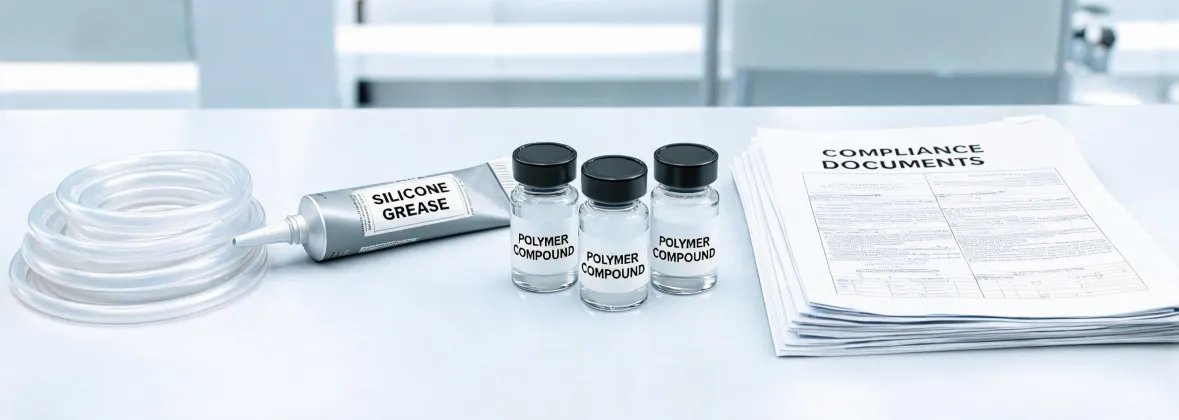
Most engineers ask the wrong question about grease
They search for "Shin-Etsu grease vs silicone grease" as if it's a binary choice. But that framing made me miss the real issue for three years (and cost me at least two rush orders I'd rather forget).
Here's my position: Stop asking which one to choose. Start asking which problem you're solving. The overlap between general silicone grease and a formulation like Shin-Etsu's is smaller than most people assume. And assuming they're interchangeable is exactly how you end up calling a vendor at 9 PM on a Friday.
My first lesson: When 'will work' means 'will fail'
Back in December 2019 — I was sourcing a dielectric compound for a two-stage automotive sensor project. The spec called for a non-curing, low-volatility silicone grease with thermal stability to 200°C. Our engineering team said: "Use standard silicone grease, it'll work."
It didn't.
The compound we used — a standard commercial silicone grease — outgassed during the thermal cycling phase. By the time the first 50-unit batch reached our client's assembly line, eight units had failed insulation resistance testing. The line stopped. Our client had a $12,000 penalty clause hanging over a component we'd supplied.
We replaced every unit with Shin-Etsu's G-330 series. (Should mention: that was recommended by a specialist partner, not my own deep material science knowledge.) The failure rate went to zero across the next 400 units. The difference wasn't price. It was the specific formulation — a controlled molecular weight distribution and a stabilizer package designed for enclosed electronics. Standard silicone grease isn't designed for that. It's not supposed to be.
That shift cost us an extra $0.18 per unit — but saved us the $12,000 penalty. The conventional wisdom says "general-purpose options are cheaper." My experience with that 50-unit disaster suggests otherwise. Total cost matters more than unit cost.
The 'everything is silicone' myth
This is a legacy thinking problem. Ten years ago, most industrial silicone greases were variations of a few base formulations. The differences were marginal. Today — especially in semiconductor and automotive sensor applications — the gap has widened dramatically.
Silicone grease is a broad category. It includes lubricants for O-rings, sealants for vacuum systems, and dielectric compounds for connectors. They all share a silicone base — but their additives, crosslinking agents, and purity levels diverge sharply. Shin-Etsu, for instance, makes over 200 grease formulations. Most of them are not interchangeable. Treating all silicone grease as one thing is like treating ABS, nylon, and polycarbonate as "plastic." It's sometimes acceptable — and dangerous when it isn't.
I see this error most often in rush orders. A project manager searches for "silicone grease" on a distributor site, sees a low price, orders 5 kg — and then the material fails thermal resistance within weeks. The root cause isn't the supplier. It's the assumption that one chemical family maps to one solution.
When 'one-stop shop' becomes 'one-size-fits-all' (badly)
The B2B world loves the idea of the full-service supplier. I understand the appeal — fewer vendors to manage, simpler procurement, single invoices. But that convenience works best when your needs are standard. When they're specialized — and in industries like automotive electronics or medical device assembly, they almost always are — the "full-service" model hides gaps.
A vendor who claims to handle all your silicone needs usually doesn't have deep expertise in any one of them. The person selling you a sealant for an assembly line also sells the grease for your sensors and the resin for your potting application. They can answer surface-level questions. They cannot tell you — from experience — why a certain formulation fails in a sealed environment at 180°C, or why a different stabilizer package extends service life by 300%.
That's where suppliers like Shin-Etsu — or their specialized distributors — earn their place. They don't pretend to be a one-stop shop for every polymer. They focus on a vertical — say, thermoplastic elastomers distribution for automotive interiors, or low-volatility silicone greases for sensor modules — and they own that space. They tell you when standard silicone grease works, and when it doesn't. They recommend alternatives (sometimes from other manufacturers) when their product doesn't fit.
A vendor in 2022 told me, plainly: "This isn't our strength — here's who does it better." I've been a customer for three other product lines ever since. The honesty created trust that a "yes, we can do that" would have wrecked.
The pushback I usually get
"Specifying branded products like Shin-Etsu costs more and limits my options."
I've heard that at least a dozen times. It's true if you measure cost per gram. It's false if you measure total project cost — including rework, retesting, line stoppages, and reputational risk. In the high-stakes environments where I coordinate materials — often with 48-hour turnaround windows — the branded specialist solution costs more upfront and saves multiples on the back end.
"But isn't standard silicone grease adequate for 90% of applications?" Maybe. But if you're in automotive, medical, or semiconductor manufacturing, you're in the 10% where it matters. Standardizing on a general-purpose option creates risk across your entire supply chain. I'd rather have a specialist in my vendor list for the 10% of the time I really need them than scramble for an emergency replacement at a 300% premium.
Final position
I believe the "Shin-Etsu vs silicone grease" debate is a symptom of a deeper problem: we've trained procurement and engineering teams to think in categories rather than in properties. The question isn't which brand. The question is: what exact performance do you need, and which supplier can deliver that performance with evidence and support?
If the answer is "a general silicone lubricant for low-demand applications," standard silicone grease is fine. But if you need thermal stability at 200°C, low outgassing in sealed electronics, or compatibility with specific ABS compounds from your ABS company partner — then treat it as a specialty requirement. Specify the specialist. Your schedule (and your client's penalty clause) will thank you.
I've learned this the hard way — through a $12,000 failure in 2019, through at least five emergency shipments I could have avoided, and through enough vendor conversations to know that the supplier who says "this is our narrow expertise" is more valuable than the one who promises everything.
So my advice: stop debating "Shin-Etsu grease vs silicone grease." Start asking "what specific problem am I solving?" And if you need a specialist, admit it early. It's cheaper that way.