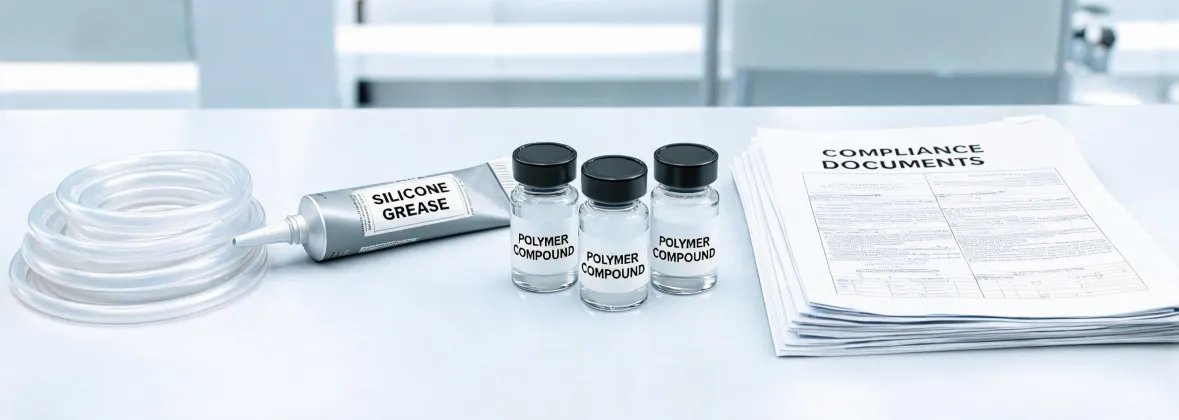
Last month I rejected a lot that the supplier swore was “basically the same.” The part looked right. The dimensions looked right. But the drawing didn’t call for “silicone grease.” It specified a silicone grease from Shin-Etsu. When I asked for the certificate of analysis, the supplier said the generic version was “just as good.” That sentence has cost manufacturers more money than most people want to admit.
Look, I’m not a brand snob. There are plenty of places where a generic silicone grease is perfectly acceptable. The problem isn’t brand versus no brand. The problem is that the word “silicone” gets used as if it means one material with one set of properties. It doesn’t. It’s a family: oils, greases, rubbers, sealants, gels, and resins. Each member has a different job.
The Search That Starts in the Wrong Place
If you searched shin etsu grease vs silicone grease, you’re not crazy. It’s a normal thing to do when a spec says “use Shin-Etsu” and a supplier says “use our silicone grease instead.” But the frame is off. Shin-Etsu grease is not the opposite of silicone grease. It’s a silicone grease from Shin-Etsu.
The real comparison is: which silicone grease? What’s in it? What is it expected to do? What test data comes with it?
Most silicone greases use silicone oil as the base. But they’re thickened differently, formulated differently, and qualified for different temperature ranges, outgassing requirements, and material compatibility. A grease that works for an electrical connector can be wrong for a high-heat application. A grease that works in a cleanroom might not survive a vibration test. The brand name is only shorthand. The specification is what matters.
So when someone searches shin etsu grease vs silicone grease, the question they’re really asking is: “Will the substitute meet my specification?” And that question cannot be answered by a search box.
The Category Problem Hides Behind the Noun
This confusion goes far beyond grease. In incoming inspection, we see the same pattern with rubber parts, molds, and sealants. And it usually comes back to one underlying issue: people treat the word “silicone” as a complete technical description.
Take the question, “is thermoplastic elastomer silicone?” The short answer is no. TPE is a processing and performance category, not one chemistry. Many TPEs are not silicone at all. Silicone rubber is a cross-linked polymer that cures and doesn’t melt the way a thermoplastic does. There are hybrid materials, but they’re not what most drawings mean when they specify silicone.
That difference matters more than people think. A TPE part can look and feel like silicone. It can even be colored and molded the same way. But if the application requires long-term heat resistance or low compression set, a TPE substitute may not survive. It might work for a while. Then it softens, deforms, or leaks.
This is also why a search like “rose silicone mold” can be dangerous. You can find a flexible mold labeled as a rose silicone mold. Some are true silicone. Some are TPE or another flexible polymer that simulates silicone. For a decorative product used a few times, that difference might not matter. For a production process, it does. If the mold sees heat, cycles, or repeated flexing, the polymer family determines how long it lasts.
The same thing happens with “shower silicone.” A product labeled shower silicone is usually an RTV sealant intended for bathrooms. It’s a legitimate silicone product, but it’s not a silicone rubber sheet, a grease, or a mold material. The cure system also matters. Some are acid-cure. Some are neutral-cure. On sensitive metals or electronics, the wrong cure chemistry can be a disaster.
The question everyone asks is, “Is it silicone?” The better question is, “What silicone? Which grade? Which cure system? Which performance property is critical?”
The Real Cost of Ambiguity
The clearest example I saw last year involved a gasket. The specification called for silicone rubber. The molder proposed a TPE lookalike. It saved about six cents per piece. On an order of 8,000 pieces, that looked like a smart move—about $480 in savings.
The problem showed up in the heat-aged compression set test. The part couldn’t hold the required force after being exposed to heat. It wasn’t a visual defect. It was a functional failure that would have appeared after installation. We rejected all 8,000 parts. The re-testing, downtime, and expedited replacement cost around $22,000. The supplier said it was “within industry standard.” Our specification didn’t ask for “industry standard.” It asked for a defined silicone product.
Another case was less dramatic but just as important. A generic grease passed every initial test. The numbers looked good. My gut said to check the traceability. The supplier couldn’t provide a lot number or a certificate of analysis. The spreadsheet said “go.” I called an authorized distributor anyway.
Would that generic grease have failed? Maybe. Or maybe not. But we had a customer trial scheduled, and the cost of uncertainty was higher than the cost of waiting. The spec requirement wasn’t just chemical performance. It was proof.
When a Deadline Is Non-Negotiable
Deadlines change how you look at substitution. If you have weeks of buffer and a low-risk application, testing a generic alternative might be reasonable. But when a customer line is waiting or a regulatory date is fixed, cheap and uncertain is more expensive than expensive and certain.
In March 2024, we paid extra freight to get a certified product from an authorized distributor. The extra cost was around $400. The customer trial we protected was worth far more than that. The cheaper option wasn’t really cheaper. It was a gamble with a schedule attached.
That’s why I prefer to buy from acknowledged Shin-Etsu silicone distributors when a controlled lot is required. Authorized distributors can provide lot traceability, certificates, and technical support. A generic distributor might still sell a good product, but if there’s no lot record, you can’t investigate a failure. You can only guess.
This isn’t about avoiding all generic silicone products. It’s about knowing what you’re actually approving. If someone can’t tell you the cure system, the hardness, the temperature rating, or the product’s origin, then the word “silicone” is doing too much work.
Next time you compare shin etsu grease vs silicone grease, remember that the label is only a starting point. Ask for the catalog number. Ask for the property that matters. Ask for the test data. And if someone says “it’s basically the same,” ask them to prove it.
If they can, you have a real alternative. If they can’t, you’re not saving money. You’re just accepting an unknown. And when a deadline depends on that part, an unknown is the most expensive ingredient you can add.