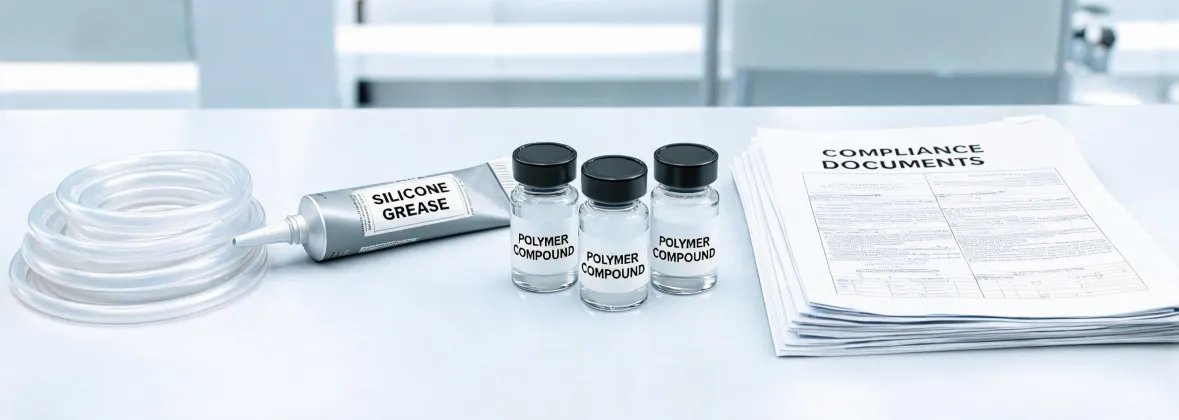
If you're reading this because you have a deadline on your back and a spec sheet that doesn't quite add up, you're in good company. I coordinate urgent material orders for manufacturers, and the question "which polymer do I actually need?" comes up at least once a month—often on a Friday afternoon.
Here's the honest answer: it depends. There's no universal "best" Shin-Etsu product, and anyone who tells you otherwise is simplifying your problem. So this guide is built like a decision tree. Find your scenario, follow the branch, and you'll know what to order. If you're still torn, send your specs to a technical rep at Shin-Etsu Silicones of America or one of their authorized distributors. That's literally what they're there for.
Four scenarios, four different answers
After 200+ rush material calls, I've found that most silicone-related emergencies fall into one of four buckets:
- You're lubricating rubber or plastic parts.
- You're molding a flexible part—case, band, seal, gasket.
- You need transparency in a flexible material.
- You're weighing silicone against a non-silicone polymer like PEG.
Here's what I'd advise for each one.
Scenario 1: Lubricating rubber seals or moving plastic parts
This is the most common emergency request I get, and the answer is almost always Honda Shin-Etsu silicone grease.
If you're working on door seals, sunroof rails, O-rings, switch assemblies, or any spot where rubber slides against something, a silicone grease is the safe call. It doesn't attack EPDM rubber the way petroleum-based lubricants do. It holds up across a wide temperature range. And it doesn't dry out the way lighter oils do.
The "Honda" in the name is a clue to how good this stuff is: it's the factory-specified grease for Honda door weatherstrips, sold in those little 50g tubes (often referenced as part number 08798-9002). But you don't need to own a Honda to use it. The tube is just the most convenient package size for any automotive or electronics assembly job.
My rule of thumb: if the part is rubber and it moves, use silicone grease. If it's metal-on-metal under heavy load, reach for a molybdenum disulfide grease instead. Don't mix the two use cases.
One red flag though: silicone grease will ruin paint adhesion. If a part gets painted after assembly, a single fingerprint of silicone causes "fish eyes" that show up in the paint booth. We had a contract job in March 2023 where a technician used a silicone-based grease on plastic clips that were scheduled for paint bonding the next day. Every piece came back with tiny circular voids in the coating. That was a $3,400 rework for a $200 grease mistake. I still kick myself for not flagging the paint step on the work order.
(And yes, I did read the datasheet afterward. It said exactly that. The datasheet always knows.)
Scenario 2: Making flexible parts—silicone vs TPU
This is the classic silicone vs TPU debate. Both materials feel similar at first touch, but they behave very differently in production and in service.
Choose silicone when:
- Temperature exposure matters. Silicone typically survives from about -50°C to 200°C; TPU starts softening around 80-90°C.
- Soft-touch matters. Silicone has that matte, skin-like feel TPU can't quite match.
- The part gets sterilized or washed repeatedly. Silicone handles autoclave cycles much better.
- Skin contact is involved. Silicone is generally well tolerated.
Choose TPU when:
- Abrasion and tear resistance matter more than temperature. TPU can be scraped, stretched, and abused well beyond silicone's limits.
- You need a thin, structurally strong wall section. TPU keeps its strength in thin cross-sections; silicone tears more easily.
- Cost is the deciding factor. TPU is usually cheaper per kilogram and cycles faster in injection molding.
To be fair, many clients expect silicone to be the universal answer. It's not. Last year, a customer needed a rush run of watch bands to replace an existing TPU design. They switched to silicone because a molding slot was available on the right schedule. Three weeks later, the bands were failing at the lug holes—silicone's lower tear strength couldn't handle that thin, tension-bearing section. The material was fine; the material choice wasn't.
So the counterintuitive part: when your part has thin sections under load, TPU is usually the stronger pick. Silicone wins on heat, feel, and chemical resistance—not toughness.
Scenario 3: Silicone glasses and optical clarity
The phrase silicone glasses throws people off. Sometimes it means eyeglass frames made from silicone (usually just the nose pads and temple tips). Sometimes it means transparent silicone components for lens covers, LED diffusers, or sensor windows.
For eyewear: silicone is great for nose pads and flexible frame parts. It doesn't absorb skin oils, it's comfortable, and it stays flexible in cold weather. But silicone surfaces scratch easily. If the part has to stand in for an actual lens, you need real glass or coated polycarbonate, not silicone.
For optics: there are optical-grade silicone grades that give you transparency plus flexibility plus heat resistance. That three-way combo is rare. The tradeoffs are price and molding behavior. Too high a mold temperature causes haze, and even the right temperature can leave surface defects.
I don't have hard data on industry-wide rejection rates for optical silicone molding. What I can say anecdotally: haze and flow marks account for maybe 10-15% of first-shot rejects in our orders. You build that into your yield estimate.
If a client asks "why not just use acrylic?"—honest answer: acrylic is clearer and much cheaper, but it's rigid and doesn't handle heat. Silicone glasses (optical silicone) are the right call only when you need clarity and flexibility and heat tolerance together. Remove any one of those requirements, and you can probably save money with another polymer.
Scenario 4: Silicone vs polyethylene glycol polymer
Polyethylene glycol—PEG—gets compared with silicone more than you'd think. They do opposite things in the presence of water.
PEG is water-soluble. It absorbs moisture, dissolves slowly, and shows up in pharmaceutical coatings, personal care products, and water-based mold releases. Silicone is hydrophobic. It repels water, maintains its lubricating film, and doesn't wash out. So if your application involves aqueous environments—drug release, water-soluble films, skin-contact gels—PEG might be exactly right. If you need waterproofing, silicone wins.
Quick field test: put a drop of PEG on one fingertip and a drop of silicone fluid on another. Rub them. PEG dries down to a film that rinses off with water. Silicone stays slick and beads water. That one distinction drives most material-selection decisions here.
Honestly, I'm not sure why more engineers don't start by asking "will this part ever touch water?" My best guess is that datasheets lead with chemistry and people get lost in viscosity numbers before reaching the water-contact question.
And a word on biocompatibility: just because a polymer is "used in medical" doesn't mean the specific grade you're ordering is certified. Always request the ISO 10993 or FDA documentation from your supplier. If you buy from Shin-Etsu directly or through a distributor, they can provide the certificate if the product has one. If they can't, treat that as a red flag.
One more thing: if you're making environmental claims about either material—"recyclable," "eco-friendly," "biodegradable"—the FTC Green Guides require those claims to be substantiated. Silicone's recyclability depends on the specific formulation and local recycling facilities. Don't put "100% recyclable" on a package unless you can prove it. (Source: ftc.gov, 16 CFR Part 260)
How to tell which scenario you're in
When you're on the clock, run through this checklist:
- Are you lubricating a rubber or plastic assembly? → Scenario 1. Honda Shin-Etsu silicone grease is the no-brainer—just keep it away from paint lines.
- Are you molding a flexible 3D part? → Scenario 2. Compare tear strength and service temperature before you commit to silicone or TPU.
- Does the part need to be transparent and flexible? → Scenario 3. Look for optical-grade silicone and expect some yield loss.
- Is the application wet, aqueous, or medical? → Scenario 4. Decide between water resistance (silicone) and water solubility (PEG), then verify biocompatibility documentation.
Most urgent calls I take land in scenario 1 or 2. The silicone vs TPU question comes up constantly in consumer goods; the grease question comes up constantly in automotive and electronics repair.
One last thing for the small-buyer crowd: don't be shy about ordering small quantities. When I was starting out, I placed a $180 sample order with a Shin-Etsu approved distributor, and they processed it with the same care as a bulk order. Ask for samples, ask for datasheets, and ask the technical rep to sanity-check your selection. Shin-Etsu Silicones of America's distributor network handles these requests every day. Small doesn't mean unimportant—it means potential. The vendors who ignored my early $200 orders aren't the ones getting my $20,000 purchase orders now.
Bottom line
Shin-Etsu makes some of the most consistent silicone products you can buy, but the brand name doesn't remove your responsibility to choose the right chemistry. Grease for rubber contact, silicone for heat and soft-touch, TPU for toughness, PEG for water-soluble needs, and optical silicone only when clarity, flexibility, and heat resistance all matter at once.
Still up in the air? Call a Shin-Etsu distributor with your spec sheet and ask them to confirm your scenario. They'll take it from there. And if you're in a true emergency, the checklist above will get you to the answer faster than I can quote a rush order.