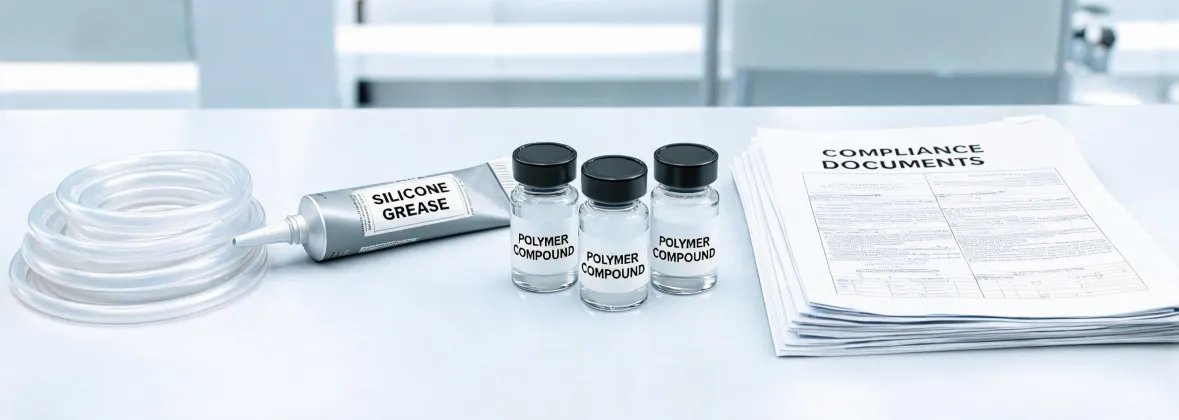
The Bathroom Silicone Problem Nobody Wants to Own
I review material specs and incoming batches for a manufacturer that buys a lot of silicone-based products. Roughly 300 line items a year — maybe 280, I'd have to check. In Q1 2024 alone, I rejected 7% of first deliveries. Maybe 6%, I'm mixing it up with Q4 2023. The reason isn't usually visible damage. It's a mismatch between what the label says and what the material actually is.
You've probably seen the milder version of this at home. The bathroom silicone bead around a tub starts discoloring after six weeks. It peels in one corner. Or it smells like vinegar every time the shower warms up. The installer blames the tube. The tube blames the installer. The truth is more annoying: most "bathroom silicone" is a category, not a material spec.
It took me about six years and more rejected batches than I care to count to understand that the word "silicone" on a spec sheet is the beginning of a question, not the end. Put another way: silicone is a category, not a material.
What "100% Silicone" Actually Means
Let me get the chemistry out of the way without pretending to be a polymer textbook. "Silicone" is a polymer family built around a siloxane backbone. Within that family, you have condensation-cure, addition-cure, peroxide-cure, acid-cure, neutral-cure. You have sealants, greases, elastomers, resins. A tube of "bathroom silicone" is usually a one-part, moisture-cure sealant. That's a valid product. But it's not the only product, and it's definitely not a universal spec.
Per FTC advertising guidelines (ftc.gov), claims have to be truthful and non-misleading. "100% silicone" might be truthful, but it's also nearly useless. It tells me the tube doesn't contain latex or acrylic. It doesn't tell me how the material cures, what it's supposed to bond to, or how long it stays flexible.
At work, we require a full datasheet: cure chemistry, durometer, tensile strength, elongation, tear resistance, compression set, volatiles content. If a supplier can only tell me "it's silicone," I don't put that on a drawing. Not because the material is bad, but because I don't know what I'm buying.
The "TPU Silicone" Confusion: What Is TPU Silicone?
One search term that makes me cringe is "what is TPU silicone?" Because it's not a standard material. TPU is thermoplastic polyurethane. Silicone is a polysiloxane. They're both elastomers, but they're different enough that mixing them up can cause a real failure.
There are hybrid materials: silicone-modified TPU, thermoplastic silicone elastomers, silicone-coated TPU. But if a datasheet just says "TPU silicone," I don't know whether I'm getting a hard, abrasion-resistant polyurethane with a soft-touch coating or a silicone part with some polyurethane blended in. Those are different products with different failure modes.
I learned this the hard way. I assumed "same specifications" meant identical results across vendors. Didn't verify. Turned out each vendor had a slightly different interpretation. One "TPU silicone" keypad softened after exposure to isopropyl alcohol. Another turned into a sticky mess in a warm warehouse. Same drawing number. Not the same material.
The "Silicone Gag" Issue Is Usually Volatiles
If you're here because you searched "silicone gag," let me talk about the version of that question I deal with as a quality person: why do some silicone products trigger a gag reflex or an unpleasant taste?
It's usually not the silicone itself. It's what's left in it. Low-grade, peroxide-cured or acid-cure silicones can contain residual crosslinkers, catalysts, and low-molecular-weight siloxanes. Those volatiles evaporate after curing. That's why fresh bathroom silicone can smell like a vinegar bomb. In a mouth-contact or nasal product, that off-gassing can be physically unpleasant enough to make someone gag.
For healthcare or food-contact applications, specify a low-volatile, addition-cure (platinum-cured) silicone. Shin-Etsu Silicones of America, for example, publishes separate product lines for healthcare materials, and they are specific about volatiles and biocompatibility. That's the kind of detail you need when the material is near a mucous membrane.
What Failed Bathroom Silicone Actually Costs
The cheapest tube of bathroom silicone costs maybe six dollars. The wrong tube costs a lot more.
In 2023, I reviewed a remediation after a 42-room hotel renovation. The contractor used a general-purpose "kitchen and bath" sealant in walk-in showers. It looked fine at walkthrough. Eight months later, seven of the showers had dark mold lines at the bottom edge. Remediation cost was just over $22,000, plus three weeks of rooms out of service. The sealant wasn't counterfeit. It was the wrong grade for a constantly wet, high-humidity environment.
If you want another reason bathroom silicone fails, it's that people think the tube is the whole system. It isn't. The sealant needs a clean, dry surface and enough time to cure. A label that says "cures in 24 hours" often means "cures in 24 hours if the temperature and humidity are ideal." In a damp shower niche, it can take twice that. The product wasn't lying. The conditions were.
I've also been on the other side. I once skipped a cure test on a batch of sealant because "it's basically the same product we've used for years." The batch didn't cure fully in humid conditions. 8,000 units were affected. We caught it before shipping, but only because a line operator noticed the smell. I knew I should test every new batch. The odds caught up with me.
That's the pattern: it's rarely the one tube. It's the assumption that "silicone" is enough information.
What I Actually Do Now
When I implemented our verification protocol in 2022, the first thing we changed was material spec review. We stopped accepting vague categories. After enough batches and enough redos, I've settled on a few rules:
- Treat "silicone" as a category. Demand cure chemistry, hardness, and a datasheet with test methods before you approve anything for production.
- For bathroom sealing, use a product designed for wet rooms, and check if it's neutral-cure if you're sealing around acrylic, stone, or electronics. Acid-cure has its place, but a lingering vinegar smell isn't a minor issue.
- For moving parts and rubber seals, use a silicone grease, not a sealant. Shin-Etsu silicone grease is a specific example: it's formulated to lubricate rubber and metal, not to fill gaps. It can save a mixer cartridge or an o-ring that would otherwise wear and crack.
- If a material is going near food or skin, buy from a supplier who can prove low volatiles and biocompatibility. That's where brands like Shin-Etsu Silicones of America make a difference.
The last rule, if you ask me, is the one most people skip: when the deadline is fixed and a failure is expensive, pay for certainty. In March 2024, I paid $400 extra for an expedited order of a specialty silicone part. The alternative was missing a $15,000 production slot. That $400 bought a guaranteed delivery date instead of a "probably next week" promise. I'd do it again.
I'm not 100% sure why we keep expecting a $6 tube to solve a chemistry problem. Maybe because it's in a tube and looks like caulk. But bathroom silicone keeps failing when we treat it as a commodity. It's not. It's a chemistry decision. Once you understand that, the fix is usually simple: pick the right grade, test it, and don't let a cheap tube make expensive decisions. At least, that's been my experience in industrial sourcing.