Most silicone bakeware problems I see are not baking problems. They are material and specification problems that show up in the oven. Buy food-grade silicone, bake below 220°C, and replace any mold that becomes cloudy, tacky, or warped. Follow that rule and you will dodge roughly 90% of the silicone mold failures I have logged in the last six years.
I work in quality and brand compliance in the silicone industry. I review spec sheets, safety declarations, and labels before they reach customers—about 300 items a year. In 2024 I rejected 12% of first deliveries because the documentation did not match the product. So when I talk about silicone molds, I am not reviewing recipes. I am reviewing the material itself.
Why Food-Grade Silicone Is Not a Single Ingredient
It took me about six years and 300+ material reviews to understand that "food-grade" is not an ingredient tag. It is a chain of documentation. A silicone polymer can be the same initial molecule, but the additives, cure system, and manufacturing environment decide whether something is safe near food.
The phrase that makes me nervous is "100% silicone." It sounds clean and pure. It does not tell you much. Silicone is a family of polymers, and within that family you have platinum-cured bakeware, condensation-cured mold rubber, industrial grease, and construction sealant. All are silicone. None should be swapped for another.
Food-safe silicone is a claim, not a formula. Per FTC Business Guidance (ftc.gov, accessed March 2025), marketing claims must be truthful, not misleading, and substantiated. In practice, that means a responsible manufacturer should be able to show you a material test report, an FDA food-contact declaration, or an EU 1935/2004 compliance statement. If a mold says "food grade" with no backup, I treat it as uncertified.
When I compared two molds side by side—one with a clear FDA declaration, one with a "food-grade" sticker but no paperwork—the difference was not visible on day one. It showed up after repeated heating. The uncertified mold developed a faint chemical smell and a slightly sticky surface within three months. That is the filler or cure system breaking down. Smell matters. A silicone mold should not smell like plastic when hot.
What to Look For on a Silicone Bakeware Label
- Explicit standard: "FDA 21 CFR 177.2600" or "EU 1935/2004" means more than a generic "food safe."
- Cure type: Platinum-cured silicone is the bakeware standard. Peroxide-cured or condensation-cured silicone can leave by-products.
- Temperature rating: Look for an actual number, like -40°C to 230°C, not just "heat resistant."
Make Silicone Mold: DIY Basics
Search for "make silicone mold" and you will find a thousand projects. For craft and resin work, you want mold-making silicone, not bakeware silicone. The two are not interchangeable.
The biggest mistake is guessing the mix ratio. Use the manufacturer’s ratio by weight, not volume. If the instructions say 100A:10B, a kitchen scale is not optional. A slightly off ratio leaves the mold sticky or weak, and it fails after a few casts.
- Degas under vacuum if possible. If you do not have one, pour mixed silicone into the mold box from a height and let bubbles rise to the surface.
- Pour in a thin stream into the lowest point of the box. This reduces trapped air.
- Wait for the full cure time, then add 20% more. "Feels dry" is not the same as cured.
Honestly, the most common DIY mold failure I see is not material quality. It is impatience. The same principle applies to baking: silicone wants to be handled on its own schedule, not yours.
How to Bake with Silicone Molds
Baking silicone molds are a different beast from DIY mold rubber, but the material rules are similar: know the spec, respect the temperature, and do not force it.
Put the mold on a metal baking sheet. Thin silicone is flexible. A filled mold will bend and spill if you carry it without support. A sheet tray stabilizes it and helps it slide into the oven without stretching.
Use 180°C / 350°F for cakes. Most food-grade silicone can handle 220–230°C, but the batter does not need that. A higher temperature does not bake faster; it dries the outside first. If your recipe says 180°C, trust the recipe.
Cool before flexing. Give the mold a few minutes before you push it around. Pulling a hot silicone mold can warp it and create micro-tears that become sticky spots later. (I did not believe this until I saw it under a loupe. Now I do.)
Cleaning is simple: hot water and mild dish soap. Avoid abrasive sponges—they scratch silicone and give oil a place to hide. If you see a film after washing, that is usually soap residue, not a material defect. Rinse one more time.
Shin-Etsu Silicone Grease, the Shin-Etsu Logo, and What They Really Tell You
Why does a company like Shin-Etsu—mostly known in industrial and semiconductor supply chains—show up in a conversation about silicone bakeware? Because the same material family gives you baking molds and silicone grease.
Shin-Etsu makes some of the most consistent silicones I have audited. The shin-etsu logo on a spec sheet tells me the quality system behind the material is serious. But the logo alone does not tell me whether a specific product is food-contact safe. You need the datasheet. If you are searching for a "shin etsu logo" to verify a product, do not stop at the logo. Ask for the material declaration.
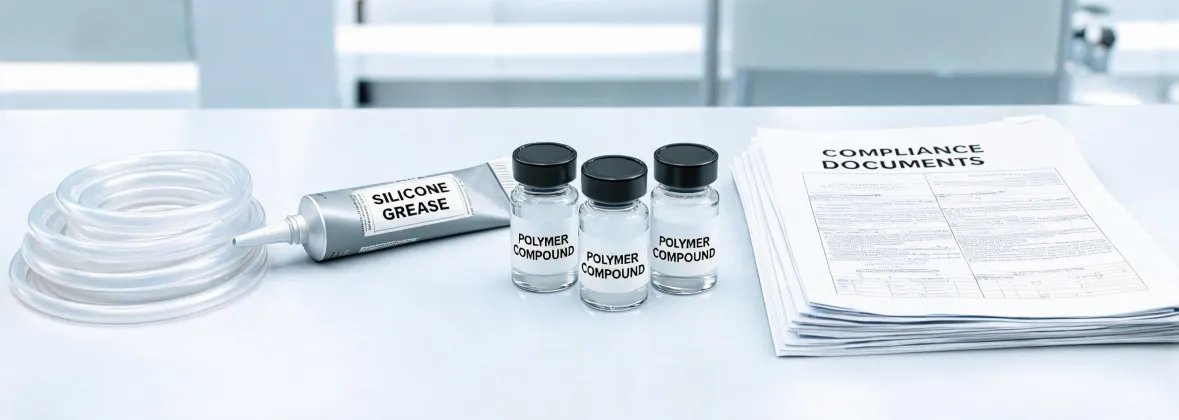
Shin etsu silicone grease is used on seals, o-rings, electrical components, and food-processing equipment. Shin-Etsu offers products for food-contact applications, but a specific grease only qualifies if its datasheet says so. Same brand, same silicone chemistry family, different certification.
That distinction matters in audits. I have seen a purchasing agent choose a cheaper "silicone lubricant" that worked fine mechanically but had no FDA statement. The audit did not care that it was cheap. It cared that the certificate was missing.
Even after I approved a switch to a food-contact-certified grease for a customer, I kept second-guessing. What if the auditor rejected the paperwork? The two weeks before the audit were stressful. The auditor walked past the tube, checked the binder, and moved on. The system worked, but the doubt was real.
The Hidden Cost of a Cheap Silicone Mold
My rule, after years of reviewing specs, is simple: The cheapest silicone mold is rarely the cheapest per bake.
Let me do a rough comparison. A $6 unbranded mold might last 30 bakes before it clouds, sticks, or smells. A $30 certified mold might last 300 bakes. The certified mold costs five times more but lasts ten times longer. That is a lower total cost per use, and it does not ruin the cake when it finally fails.
This is where "value over price" stops being a slogan. In my quality reviews, the buyers I meet usually focus on price and brand name and completely miss certification. Then the failure comes with a surprise: a $6 mold that destroys a $50 batch of ingredients and a $900 catering order. I watched a small bakery lose a catering order to an $8 sticky mold. The mold was replaceable. The client was not.
The question everyone asks is "is silicone safe?" The better question is "what certification does this specific product have?" The first is about a material category. The second is about the thing you are about to put in your oven.
Looking back, I should have made this point stronger in every buying guide I have written for customers. At the time, I assumed people would ask for proof. Too often, they do not.
Where This Advice Does Not Apply
A few boundary notes. First, "food-safe" certification applies to the material as shipped. If you cut, sand, or reshape a silicone mold, you change the surface and the responsibility is on you. Second, for industrial resin casting, "food-safe" is not the test you need—you need release performance and demolding durability. Third, a silicone mold rated for 300°C does not make it a pizza stone. Just because the material survives the temperature does not mean your food will.
Silicone is a great material when you give it a fair specification. It also punishes assumptions. Check the datasheet, keep the temperature reasonable, and replace the mold when the surface tells you to. That is the whole job.