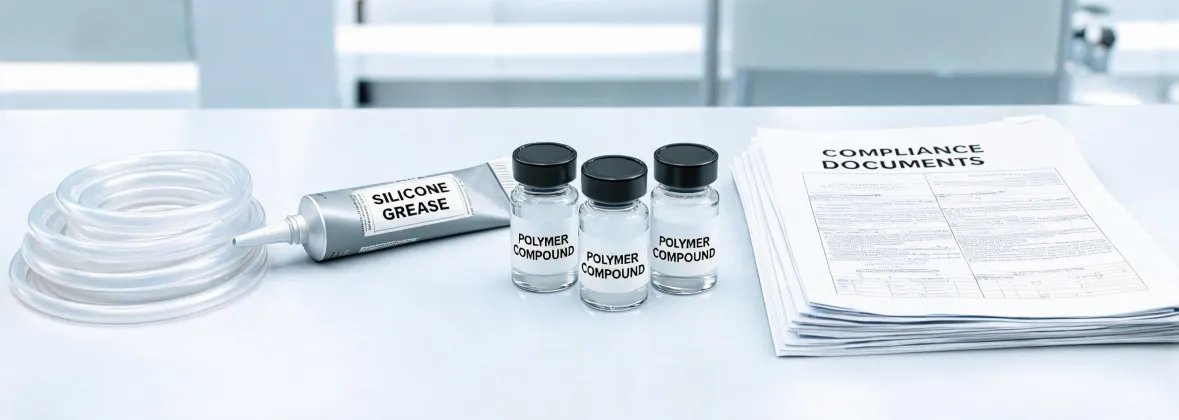
The package arrived on a Tuesday. Inside a flimsy gray envelope: a ziplock bag of silicone finger cots, a one-page “Certificate of Authenticity,” and a product sheet with a Shin-Etsu logo printed at the top.
My cleanroom supervisor picked up the bag and turned it over. “Looks right,” she said. “Same blue packaging. Same brand. And 25% less than what we’re paying now.”
She wasn’t wrong about the price. That was the problem.
When Our Silicone Supplier Raised Prices 22%
Two weeks earlier, our long-time supplier—an authorized Shin-Etsu distributor—announced a 22% price increase across their silicone line. Our annual spend on finger cots alone was $3,600. The hike pushed it to $4,392. On a product that hadn’t changed in five years.
Some background on me: I’m the procurement manager at a mid-sized electronics manufacturer, about 200 employees. I’ve managed our raw materials budget for six years, tracked every order in our cost system, and negotiated with more vendors than I can count. Total materials spend: roughly $180,000 a year. When one line item jumps 22%, that’s not a number I just accept.
Shin-Etsu (people often type “shin etsu” when searching) is one of the largest silicone manufacturers in the world. They don’t sell direct—they sell through authorized distributors. So when our distributor raised prices, I had two choices: accept it, or find a better-priced authorized source.
I pulled quotes from three vendors.
The first was another authorized Shin-Etsu distributor. Responsive, professional, and priced about the same as our current supplier. The second was a plastics company we’d used years ago for custom HDPE parts: HDPE Inc. The third was a listing on an online marketplace with no phone number, no address, and zero reviews—instant no.
HDPE Inc. had expanded into silicone components. Their quote undercut our current supplier by exactly 25%. Free priority shipping on bulk orders. Certificate of Analysis on every batch, they promised. Their sales rep called three times in one week.
Twenty-five percent cheaper. It got my attention.
The Spreadsheet Said Switch. My Gut Said Wait.
I went back and forth between the authorized distributor and HDPE Inc. for two weeks. The distributor offered reliability and real traceability, but the price was painful. HDPE Inc. offered $900 a year in savings on finger cots alone—money I could move to other material lines that were also creeping up.
I ran the numbers in a TCO spreadsheet. Every cost analysis pointed to HDPE Inc. But something felt off.
Maybe it was the sales pitch. Every question I asked got the same canned answer: “We supply genuine Shin-Etsu materials, fully certified, with full traceability.” But when I asked for a sample, there was a pause. A long one.
The sample finally arrived in that gray envelope. It had a $0.73 USPS First-Class stamp on it—the standard letter rate, per USPS, as of January 2025. One stamp. That’s how a “certified cleanroom supplier” shipped a validation sample. Here’s what I mean: a real distributor sends samples in sealed packaging with lot labels and a pouch for the CoA. This looked like a birthday card.
Not ideal, but workable, I told myself. Then I looked at the logo again.
The Shin-Etsu Logo That Didn’t Match
The Shin-Etsu logo is a clean, confident mark. The blue is deep and saturated. The letter spacing is tight. The registered trademark symbol is tiny, almost easy to miss.
The logo on HDPE Inc.’s packaging was... almost that. I pulled up Shin-Etsu’s official website and held my phone next to the box. The differences started to show:
- Color. The official Shin-Etsu blue is approximately Pantone 286 C. The packaging blue was washed out, like a CMYK conversion that had been photocopied a few times. Industry tolerance for brand colors is Delta E < 2—this was way beyond that.
- Print quality. A legitimate commercial logo is printed at 300 DPI or higher at final size. The edges of this logo were soft and pixelated, especially around the letters. It looked scanned, not printed from original artwork.
- Details. The ® symbol was oversized. In the real logo, it’s tiny. HDPE Inc.’s designers knew the symbol mattered but didn’t know why.
Counterfeit packaging is rarely perfect. It’s almost-right. The same washed-out blue and blurry edges appeared on HDPE Inc.’s quote and product sheet.
The product sheet also said: “100% food-grade silicone, biodegradable, eco-friendly.” Those are big claims. Per FTC guidelines, environmental claims like “biodegradable” need evidence—the FTC Green Guides are pretty clear about that. And silicone doesn’t biodegrade in any practical timeframe. So either HDPE Inc. wasn’t selling real silicone, or they were putting buzzwords on paper and hoping nobody asked.
Neither option belongs in a cleanroom.
That weekend, my sister called. She’d just bought a silicone muffin tray and asked me, “Can you bake with silicone molds?” I said yes—if it’s food-grade silicone from a brand that tests and labels it properly. She was happy with that answer. I wasn’t, because HDPE Inc. had printed “food-grade” on the same flimsy sheet as a counterfeit logo. Claims without traceability are just ink.
On Monday, I emailed Shin-Etsu’s Americas office. Subject line: “Authorized distributor verification request.” I attached HDPE Inc.’s quote and photos of the sample packaging.
The reply came the next business day. HDPE Inc. was not—and had never been—an authorized Shin-Etsu distributor. They had never purchased from Shin-Etsu. The logo, the packaging, and the certificate were unverified, Shin-Etsu confirmed.
They also pointed me to the authorized distributor list on their website. The distributor I’d been comparing against was on it. HDPE Inc. was not.
I still kick myself for not checking that list earlier. It’s public, it takes two minutes, and it would have saved me two weeks of spreadsheet debates.
The TCO That Won the Argument
Let’s put the final numbers on the table, because the surface math is what almost got us.
HDPE Inc. quote: $2,700 per year. Authorized distributor quote: $3,600 per year. Difference: $900.
But total cost of ownership isn’t a price tag. Here’s the full picture:
- Shipping. HDPE Inc. promised free priority shipping, then mailed the sample with a $0.73 stamp. If that’s how they handle a sample, imagine a bulk order.
- Documentation. Their “Certificate of Authenticity” was printed on 20 lb copy paper with no lot number, no lab reference, and no signature. It was a prop. A real CoA traces every batch to a Shin-Etsu production lot.
- Risk. In 2023, a contamination incident in our line cost us $8,400 in rework—scrapped components, lost labor, a delayed shipment. If counterfeit finger cots had shed particles onto circuit boards, the rework bill would have dwarfed the $900 we thought we were saving.
- Support. The authorized distributor’s engineers answer technical questions within hours. HDPE Inc.’s sales rep stopped returning calls the moment I asked for distributor certification.
The math was never close. $900 in savings against $8,400 of potential rework—plus the softer costs: lost production time, a delayed customer shipment, and a procurement team that loses credibility with the factory floor. The “cheap” option was expensive in every direction that mattered.
Where did we land? We stayed with our original distributor. The 22% hike was real, but we negotiated it down to 9% by committing to a two-year volume agreement. It wasn’t the $900 “savings” HDPE Inc. offered, but it was real, documented, and traceable.
How We Vet Suppliers Now
After this, I built a vendor vetting checklist and put it in a shared spreadsheet. Now it takes about 30 minutes to validate any supplier claiming to carry Shin-Etsu products:
- Check the authorized distributor list on the Shin-Etsu website. Not listed? Ask for written confirmation of their sourcing status.
- Compare the logo against official brand assets. Check the color and the print sharpness. A blurry logo is a red flag.
- Request a Certificate of Analysis with a lot number, and verify it where possible.
- Order a small sample before committing. Notice how it’s shipped, packed, and labeled.
- Run the TCO calculator—including shipping, documentation, risk, and support—not just the quote.
The checklist did more than catch problems. It made us faster. Our vendor vetting turnaround dropped from five days to about two. We stopped chasing dead ends. And in the months since, it’s already flagged a suspicious quote on another material line.
That’s the part nobody puts in a proposal: the efficiency of knowing what you’re buying. When the process works, it’s almost boring. And boring is fine by me.
Here’s what I’d tell any buyer sourcing silicone components: the Shin-Etsu logo is one of the most respected marks in this industry, which is exactly why it gets faked. Checking that logo isn’t paranoia—it’s the fastest due diligence shortcut you have.
And yes, you can bake with silicone molds. Just make sure the brand on them is real.