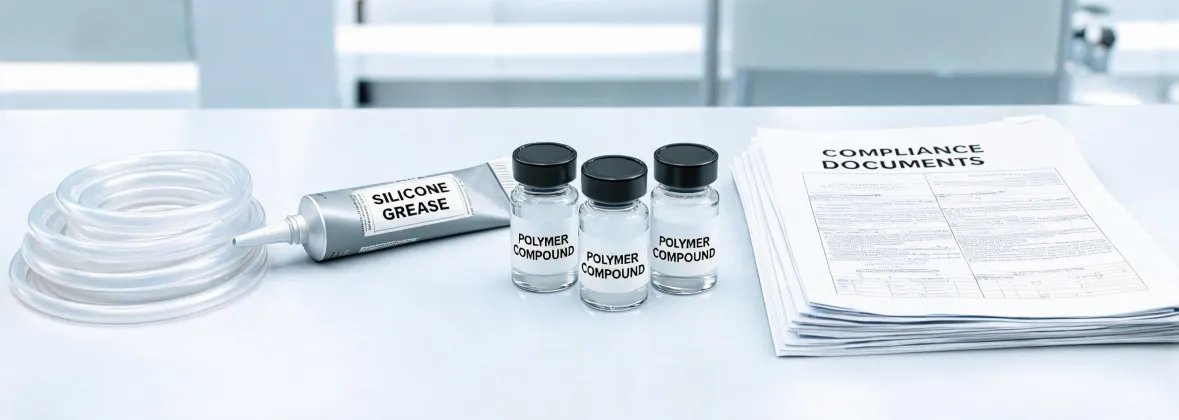
You’d think “silicone vs polyurethane” has a winner. It doesn’t. I say that as someone who spends about 60% of my week reviewing material specs, supplier certs, and first-article inspections. The other 40% is putting out fires that should’ve been caught earlier.
Here’s the thing: the right answer depends on what you’re making. Gasket? Soap mold? Grease? Structural part? These have different requirements, so they deserve different decisions. I’ve been in quality roles for over a decade, and I keep seeing the same mistake: choosing a material by name, not by spec. ‘Shin-Etsu’ is a strong name, but a strong name doesn’t equal the right material. The right material is the one that survives your environment.
Scenario 1: You’re sourcing gaskets or seals
For gaskets and seals, heat and compression set usually decide the material. Silicone gaskets handle continuous temperatures from -60°C to 200°C (depending on compound) and spring back when compressed. That’s why you see Shin-Etsu silicone specified in automotive and electronics sealing applications.
If you’re choosing a silicone gasket manufacturer, the material is only half the story. Ask for Shore A durometer tolerance, compression set data, batch-specific material cert, and lot traceability. I rejected a 3,000 gasket batch in Q1 2024 because the durometer was 60 Shore A instead of 50. The vendor claimed it was “within industry standard.” Normal tolerance for that part was ±5. We sent it back, and the redo took three weeks. That’s the kind of problem that doesn’t show up until the gasket fails on a test bench—or worse, in a customer’s assembly.
Prevention: verify the material cert before production, not after delivery. It takes 10 minutes. Also check the compression set percentage. A gasket that looks fine after a week but doesn’t return to shape at the end of the year is not a gasket; it’s a leak.
Scenario 2: You’re making soap molds or food-contact parts
For soap molds and other food-contact items, silicone is usually the right call. It releases well, takes heat and cold, and doesn’t harden like some polyurethanes. But “food-grade” doesn’t mean all silicone is acceptable.
If you’re buying material for silicone soap molds, work with shin-etsu silicone distributors that can provide the original spec and a lot number. That traceability is the difference between a smooth audit and a recall. I’ve had suppliers send me platinum-cured silicone for a drinking cup mold without actually confirming the cure process. Per FTC guidelines (ftc.gov), a “food-safe” claim must be truthful and substantiated. So if the label says food-safe, there should be a test report behind it. Ask for it before you buy.
Also, color matters more than aesthetics here. Some pigments can interfere with cure or contain heavy metals. Clear or white doesn’t always mean safe. Check the datasheet. And don’t skip the cure date: silicone compounds have a shelf life, and old material can cause adhesion issues or incomplete cure. If a distributor can’t give you the lot manufacture date, that’s a red flag.
Scenario 3: You need a rubber-safe lubricant
Sometimes you don’t need a molded part at all. You need a lubricant for rubber seals, plastic gears, or brake components. That’s where “shin etsu grease silicone” comes in.
When a maintenance spec says “shin etsu grease silicone,” it usually means a specific silicone-based grease designed to work with EPDM, neoprene, or other elastomers without swelling them. It’s not the same as ordinary petroleum grease. I’ve seen an assembly line use a cheap multi-purpose grease on a silicone seal. The seal swelled, the fit failed, and they scrapped 8,000 units in storage. The cost wasn’t the grease; it was the rework.
Prevention: test the lubricant’s compatibility with your specific elastomer at your actual operating temperature. If the O-ring material changes, re-test. And don’t assume more lubricant is better. Over-applying silicone grease can attract dust and create a paste that increases wear. Use the amount in your spec.
Scenario 4: You’re weighing silicone vs polyurethane for mechanical parts
For mechanical parts subject to repeated impact, abrasion, or high load, silicone is often the wrong choice. That’s where silicone vs polyurethane gets interesting. Polyurethane generally offers much better abrasion resistance, tear strength, and load-bearing capacity. Silicone wins on temperature range, chemical resistance, and flexibility at low temperatures.
So if someone asks “is silicone better than polyurethane?” I usually answer: “Which failure are you trying to avoid?” If heat or chemical attack kills the part, silicone. If abrasion or impact kills it, polyurethane. If both matter, you’ll need a detailed comparison test. No generic answer. I’ve had a standard 80 Shore A polyurethane outperform a specialty silicone in abrasion, and I’ve had that same polyurethane fail in a hot, humid environment where silicone was fine. It depends.
One caveat: polyurethane will sometimes beat silicone on price per part. But once you include tooling, downtime, and field failures, the numbers can flip. I’ve watched buyers choose a cheaper polyurethane for a high-heat application and spend $18,000 on rework three months later. The higher quote would have been cheaper in the end.
How to tell which scenario you’re in
Use this quick filter:
- Does the part face sustained heat above 150°C? → silicone, with a material cert.
- Does it face abrasion, impact, or heavy mechanical load? → polyurethane may be better.
- Does it contact food or skin for long periods? → silicone, platinum-cured, with test reports.
- Is the failure mode swelling or sticking? → silicone grease, and check compatibility.
If you still have both candidates, run a small prototype. Not a material datasheet comparison—an actual part test under your conditions. The datasheet says “typical values”; your part says “I need to survive Tuesday.” If you’re still uncertain, make a decision matrix. Temperature range 30%, mechanical load 30%, regulatory 20%, cost 20%. If temperature and regulatory dominate, silicone. If load and abrasion dominate, polyurethane. It sounds like bureaucracy, but it’s actually a simple prevention tool.
The cost of skipping verification
The one lesson that sticks with me is that prevention is cheaper than correction. The 20-minute spec review at the start of a project has saved us more money than any discount. There’s something satisfying about a first-pass approval—after weeks of back-and-forth, seeing production parts match the datasheet is the payoff. (I really should write this checklist down for our next project.)
Most buyers focus on per-unit pricing and completely miss lot consistency and documentation. Those are the places rework hides. And if a quote seems cheap, ask why. People assume expensive vendors deliver better quality. In my experience, it’s the reverse: vendors who deliver quality get to charge more. The causation runs the other way.
Bottom line: silicone vs polyurethane doesn’t have a universal winner. The right choice depends on your scenario, your documentation, and the integrity of your supply chain. Choose Shin-Etsu or another top-tier material, but verify it before you commit. That’s the part most people skip, and it’s the part that causes the most grief. Early verification hurts; it slows down the first week. But correction hurts more. When the batch fails, the line stops, the customer calls, and the invoice grows. I prefer the small pain.