-
Why this matters
-
Step 1: Ask why silicone, before asking which silicone
-
Step 2: Separate molded parts from extrusions
-
Step 3: Put real numbers on the material spec
-
Step 4: Get compliance and environmental claims in writing
-
Step 5: Verify the fabricator, not just the material brand
-
Step 6: Require a production sample and a dimensional report
-
What to check before you approve the PO
If you're the person stuck with sourcing silicone rubber parts and you aren't a polymer expert, this checklist is for you. It covers the questions I ask before I spend budget on silicone rubber mold parts, silicone rubber extrusions, or any compound that carries the Shin-Etsu name. Six steps, in the order I'd run them.
I'm the office administrator for a 200-person manufacturing services company. I manage rubber and plastic component ordering—roughly $150k a year across eight approved vendors. I don't do formulation. I don't pretend to. But I've made enough mistakes to know what needs to be on an RFQ.
Why this matters
A lot of purchasing advice treats silicone as one thing. It isn't. Silicone is a polymer, yes, but it's a family of polymers with different cure systems, durometers, and compliance limits. Specify it wrong and you don't just get a bad part—you get a production delay and a hard conversation with your finance team.
Step 1: Ask why silicone, before asking which silicone
If you're wondering 'is silicone a polymer?'—yes, it is. More specifically, it's a synthetic polymer with a repeating silicon-oxygen backbone and organic groups attached to the silicon. That structure gives it a wide operating temperature range and good resistance to oxidation and many chemicals. It also means it's not always the right rubber for fuel resistance, high abrasion, or steam applications.
I only believed that after watching us order a 'silicone' gasket for a diesel-exposed assembly. A good fabricator caught it and suggested a different elastomer. If they hadn't, we'd have signed off on a material that would likely have failed in the field. Now I write down the actual operating environment on every RFQ, and I let the material specialist tell me if silicone is wrong.
Step 2: Separate molded parts from extrusions
The phrase 'silicone rubber mold' can mean two things in procurement. Sometimes it means silicone rubber used to make molds, like RTV silicone. More often in our world it means silicone rubber parts made in a mold. Both are legitimate, but they're different purchase orders. If you're asking for a quote, say exactly which one you mean.
A molded silicone part is formed by placing uncured rubber into a cavity and vulcanizing it under heat and pressure. An extrusion is made by forcing uncured silicone through a die to make a continuous profile—tube, seal, gasket strip—then curing it. Tooling, tolerances, and inspection methods aren't the same.
(Should mention: I learned this from a supplier who asked 'do you want a mold for making silicone, or silicone for making your mold?' I didn't know the answer. That's when I started splitting RFQs.)
Step 3: Put real numbers on the material spec
If the only words on your drawing are 'silicone' or 'FDA grade,' stop. A material datasheet is the minimum. You want durometer (Shore A or Shore 00), specific gravity, tensile strength, tear strength, elongation, compression set, and continuous service temperature. If the part needs to survive a short heat spike, say so separately—peak temperature is not the same as continuous temperature.
I assumed 'same specifications' meant identical results across vendors. Didn't verify. Each vendor had slightly different interpretations of 'hardness 50 Shore A.' One was within tolerance; the other was 63. Now I list the test method alongside the number, like ASTM D2240 for durometer, and I ask for the physical test report from the production batch.
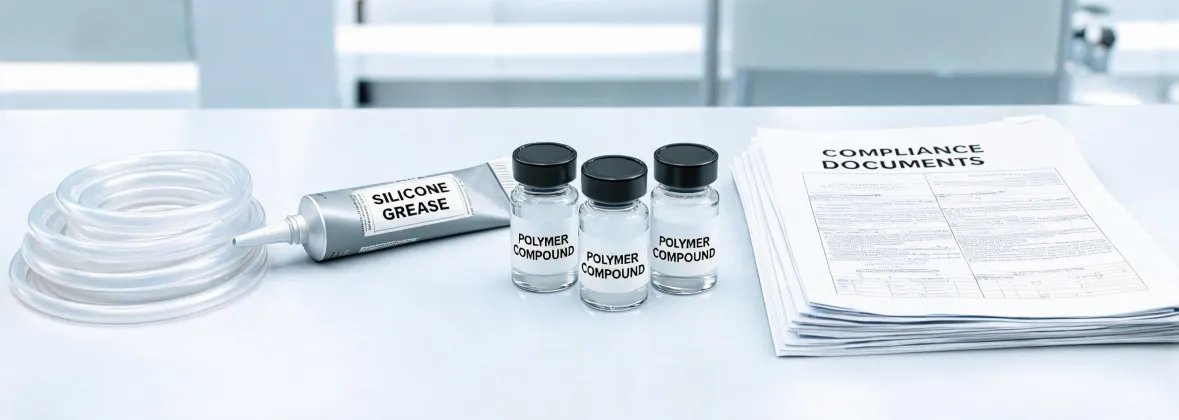
When a vendor says 'Shin-Etsu silicone,' ask which specific compound and how it's certified. Shin-Etsu has a broad product line, not one generic recipe. The same logic applies to 'shin etsu silicone grease' in an assembly: the brand just points to the manufacturer, not to the right grade. You still need to match the grease to the material, temperature, and whether it's for lubrication, sealing, or electrical insulation.
Step 4: Get compliance and environmental claims in writing
If you need food contact, medical, or flame-rated parts, do not accept a general 'safe' or 'food grade silicone' sentence in an email. Ask for the applicable regulation: FDA 21 CFR for food-contact rubber under the relevant section, USP Class VI for certain medical uses, UL 94 for flammability if it's going in electronics. If you ship to Europe, check REACH and RoHS. If your customer requires conflict minerals, ask.
The FTC is your backstop here. Per FTC Business Guidance on Advertising, claims have to be truthful, not misleading, and substantiated with evidence. And per the FTC Green Guides, if a supplier calls the product 'recyclable' or 'eco-friendly' and can't point to proof for the communities where it will be sold, that's a red flag. You can—and should—put that in your supplier questionnaire.
Source: FTC Business Guidance on Advertising and FTC Green Guides, ftc.gov.
Step 5: Verify the fabricator, not just the material brand
Shin-Etsu Silicones of America is a material supplier. They make silicone rubber compounds, greases, and other silicones. They don't necessarily make your custom molded part or extrusion. Your fabricator does. A good compound in the wrong hands can still come out as a bad part.
So I check what the fabricator actually specializes in. A shop that describes itself as a one-stop for silicone, polyurethane, thermoplastics, and metal stamping gets more questions from me, not fewer. I'd rather work with a specialist who knows their limits than a generalist who overpromises.
The vendor who said 'this isn't our strength—here's who does it better' earned my trust for everything else.
To be fair, some multi-material shops are excellent. But I verify by asking which process engineers are dedicated to rubber molding versus the other materials. If they can't explain the difference in cure systems or durometer testing, I don't need to be their first silicone customer.
Step 6: Require a production sample and a dimensional report
I skipped this once. The drawing looked right, the quote looked right, the material datasheet looked right. Then 2,000 seals arrived with flash we couldn't trim cleanly, and the durometer measured at 65 Shore A instead of the specified 55. The vendor argued that their tester was calibrated. Maybe it was. We replaced our durometer and tested again. The parts were out of spec.
Now I ask for a sample from the actual production tool, not a hand-fabricated prototype, and a dimensional report for critical features. For extrusions, I verify the cross-section in several places, not just at the end. I also cut a sample in half to look for porosity. If the supplier won't commit to this before the order, that's the wrong supplier.
You do not want to discover a durometer mismatch after the invoice is posted.
What to check before you approve the PO
- Material datasheet names the specific silicone grade, not just 'silicone.'
- Test methods match what your quality team uses.
- Compliance letters are current, branded, and signed—not a screenshot from a website.
- The fabricator can name their equipment and cure process.
- Sample approval is part of the timeline, not an add-on.
- The grease, if any, is specified as a compatible grade, not as an afterthought.
This isn't a perfect system. I'm not 100% sure every fabricator will cooperate on the first ask, but the good ones do. And if a supplier tells you they can't share test data because it's proprietary, ask yourself whether you want to bet the production line on it.
The point of this checklist is to keep the conversation grounded. Silicone is a polymer, but it's not a single thing. Shin-Etsu supplies a wide range of high-grade silicone materials, but the material is only as good as the process and the paperwork around it. A specialist who tells you where their limits are will save you more money than a generalist who says yes to everything.