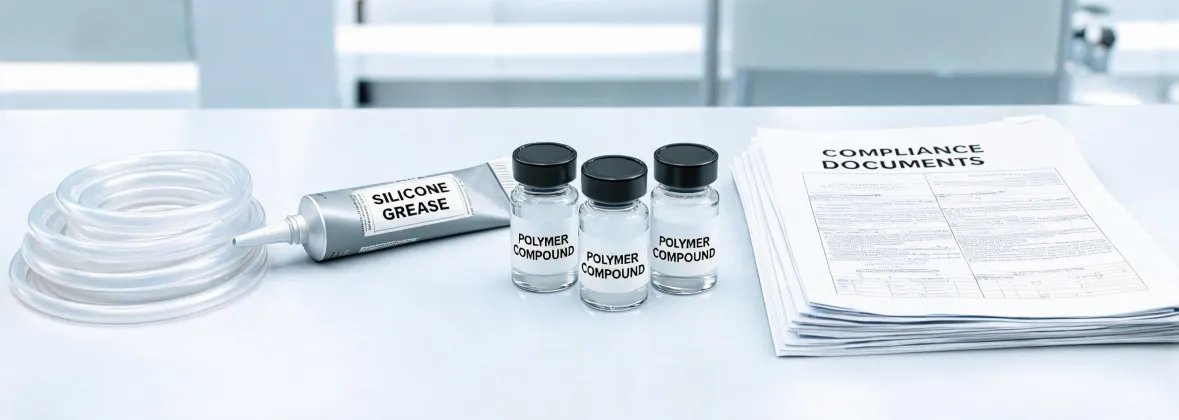
Who This Checklist is For
If you're specifying Shin-Etsu silicone for a critical application—whether it's an RTV sealant for an electronics enclosure, a polymer-filled PTFE gasket for a chemical plant, or a specialty grease for a semiconductor tool—this checklist is for you. I've been on both sides: the buyer who got burned by a bad batch, and the quality manager who had to reject a shipment that didn’t match the spec.
Here are 5 steps to vet any distributor claiming to supply authentic Shin-Etsu materials.
Step 1: Verify the Certificate of Analysis (CoA) Against Your Spec
This sounds basic, but I can't tell you how many times I've seen a CoA that's basically a photocopy of a photocopy. A legitimate CoA for a Shin-Etsu silicone product has a specific lot number, a test date, and data that matches the product's technical data sheet (TDS).
Check these three things:
- Lot number traceability: Can the distributor tell you when that specific lot was manufactured by Shin-Etsu?
- Viscosity or hardness values: For example, Shin-Etsu's RTV silicone rubbers have a specified viscosity range. If the CoA shows a value at the very edge of that range, ask why.
- Date of testing: A CoA from two years ago for a product with a 12-month shelf life? Red flag.
I once had a vendor send a CoA for 'Shin-Etsu grease' that listed a viscosity of 400 cSt. The spec for that specific grease (which we later confirmed with Shin-Etsu directly) was 1000 cSt. We rejected the batch. The vendor tried to argue it was 'within industry standard' for silicone grease. It wasn't within Shin-Etsu's standard.
Step 2: Ask for the 'Distributor Letter of Authorization'
This is the single most effective filter. A Shin-Etsu silicone distributor that is authorized by the manufacturer will have a letter (or a certificate) from Shin-Etsu Chemical Co., Ltd. stating they are an official channel. This letter usually has a specific date and a contact at Shin-Etsu who can verify it.
If a distributor can't produce this—or gives you a vague 'we've been buying from them for 20 years'—be very, very careful. There are a lot of brokers who buy excess inventory from factories and resell it. They might be selling genuine Shin-Etsu silicone. But they might also be selling a material that has been stored improperly, or that has been relabeled.
What to do: Ask for the letter. If they hesitate, move on. It's that simple.
Step 3: Verify the Packaging and Labeling
Authentic Shin-Etsu silicone products come in specific packaging. For example, their RTV silicone cartridges have a specific color scheme and barcode. I've seen counterfeit products that looked close but had a slightly off color on the label (note to self: check Pantone color on the label next time).
Here's what to look for:
- Lot number marking: It should be printed, not stuck on with a label.
- Bar code scan: Does it scan to the correct product description?
- Storage instructions: Check if the storage temperature range is correct for the product.
Step 4: Ask for a Performance Guarantee in Writing
This is where the quality inspector in me gets very specific. When you buy an RTV silicone or a polymer-filled PTFE material, you're buying a set of properties. You want that polymer-filled PTFE sheet to have a certain tensile strength at 200°C.
An authorized distributor should be willing to guarantee that the product meets the manufacturer's published data sheet. If they say 'it's a commodity product, it should be fine,' that's not a guarantee. It's a hope.
I recommend getting them to write: 'This lot of [Product Name] meets the specifications outlined in Shin-Etsu's TDS-####' right on the purchase order. If they balk, it means they're not sure of the material's history.
Step 5: Reference a Price Anchor
You need a price baseline. For industrial silicones, the price can vary wildly based on purity and volume. A polymer coating vs Teflon coating comparison is a different cost structure entirely, but for a simple silicone grease or RTV, you can get a ballpark from online industrial supply catalogs.
Based on publicly listed prices for comparable specialty materials (circa early 2025), a standard 300ml cartridge of general-purpose RTV silicone should be in a certain range. If a distributor's price is 60% below that range, something is wrong. Either it's not genuine, or it's old stock.
Bottom line: Don't chase the cheapest price on a critical material. The cost of a failure—a seal that leaks, a grease that breaks down—is always higher than the premium you pay for a verified source.
Watch Out for These Common Mistakes
Mistake 1: Confusing 'Shin-Etsu grease' with any silicone grease. This is a classic industry misunderstanding. Not all silicone greases are created equal. The 'Shin-Etsu grease is just silicone grease' thinking comes from an era when there were fewer specialty options. Today, the difference in thermal stability and outgassing can be critical for semiconductor or medical applications.
Mistake 2: Thinking an authorized distributor is always more expensive. I've found that they are often competitive on price because they have the volume. And they have support. I once saved $18,000 on a project by getting a technical application note from an authorized distributor on how to use a specific polymer-filled PTFE material, which avoided a design error.