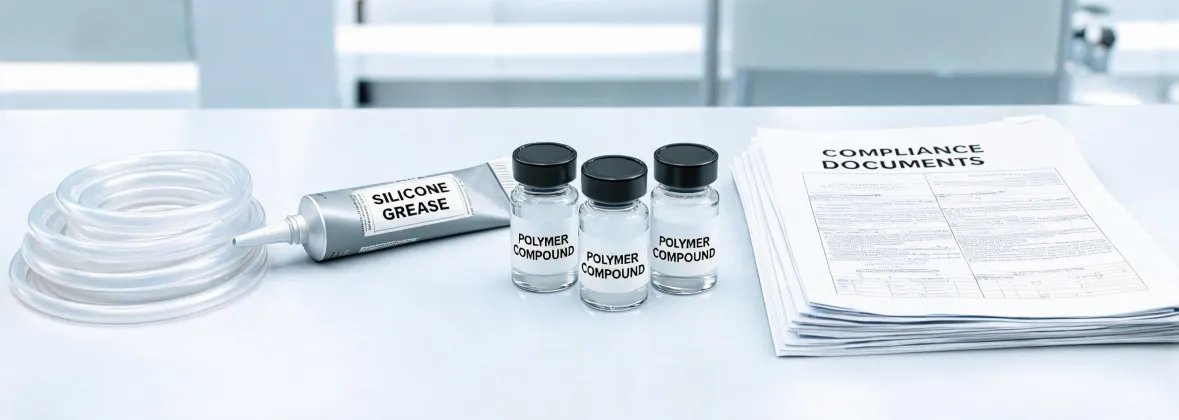
How I ended up with 400 wrong gaskets
In September 2022, I signed off on an order for 400 gaskets that were supposed to be silicone. They weren't. It took me about 10 minutes to notice, three days to get the vendor to admit it, and one reorder to fix it. The vendor ended up crediting us for the wrong material, but the redo cost $890 and the production delay was on us. Net waste: $890 plus a lost week.
I've been handling material orders for seven years, and I've personally made and documented six significant mistakes totaling roughly $2,900 in wasted budget. This was the biggest. That's why I now keep a checklist that starts with one question: is TPU silicone? The answer is no, and assuming it was cost me more than any fifteen-dollar tube of grease ever could.
The turning point: comparing TPU and silicone side by side
Back then, I used to think any rubbery polymer was basically silicone. The phrase "thermoplastic polymers" looked harmless to me. A supplier once quoted "TPU" and because I saw "elastomer" in the notes, I approved it. When the boxes arrived, the smell hit me first. Then I bent one of the gaskets and it felt crisp. A silicone gasket has a soft, elastic recovery. The TPU was firmer, more like a bendy water bottle.
I checked the datasheet—mine, the one I wrote—and there it was: "thermoplastic polymers" under the material field. The vendor had every right to send TPU. TPU is a thermoplastic polyurethane. Silicone is a crosslinked polymer with a silicon-oxygen backbone. They have different service temperatures, different compression sets, different UV resistance, and different chemical resistance. "Thermoplastic polymers" is a category, not a material. It includes TPU, TPE, nylon, acetal, and plenty of others. It does not include thermoset silicone.
When I compared the TPU gasket and the silicone replacement side by side—same durometer, same size—I finally understood why the details matter. The silicone one compressed slowly and recovered without taking a set. The TPU rebounded instantly and felt stiffer at the edges. Both might work in a door bumper. In a weather-sealed enclosure that sees Texas heat and Minnesota cold? Not for me. Seeing A/B side by side made the difference real.
The grease mistake that cost more than the grease
I thought I had learned my lesson about reading labels. Then came the Honda weatherstrip problem. The old weatherstrips on our fleet vehicles were squeaking and sticking in cold weather. Everyone said to use Honda Shin-Etsu silicone grease. I had a tube of generic "100% silicone" grease in the shop, so I figured: same base material, same job. That was wrong.
The generic grease made the rubber tackier after a few days. Not ruined, but not right. The door seal grabbed like it was coated in honey. A senior tech shook his head and told me he had warned me. He had. I ignored the warning because I was trying to save a few dollars. Then I ordered the real thing: a tube labeled Honda Shin-Etsu silicone grease, with Shin-Etsu Silicones of America, Inc. listed on the back. The difference was obvious in the texture: creamier, less oily, less likely to bead up on rubber. It seemed to soak into the surface and leave a dry protective film.
Why does that matter? Because a product specified by an automaker is tested for that application. A generic silicone grease is not. General-purpose silicone grease is fine for bearings, electrical contacts, and a bunch of other places. It is not automatically right for weatherstrips. The tube I bought cost $6. The genuine Honda Shin-Etsu silicone grease cost around $15. I also had to replace one weatherstrip for $95 and re-lubricate 11 other cars. Total price of being cheap: more than $100 and a weekend. A no-brainer in hindsight.
What my checklist looks like now
This is the part where I tell you the fundamentals haven't changed—but the execution has. Five years ago, I was placing orders with barely a glance at polymer families. It worked until it didn't. Now I have a short checklist:
- Write the polymer family on every PO: silicone, TPU, EPDM, or the exact trade name. Never "elastomer."
- If a datasheet says "thermoplastic polymers," ask which one. If the answer is "it depends," that's a red flag.
- Don't swap a manufacturer-specified grease for a generic one. Especially when the manual names a specific product like Honda Shin-Etsu silicone grease.
- If a label says "100% silicone," find out what kind of silicone and what it's for. It doesn't mean "safe for every rubber."
What I mean is that "thermoplastic polymers" is not a box you can check and move on. It's a family of materials with different melting points, flex lives, and chemical behaviors. When I write "silicone" on a PO, I also write "LSR, 50 Shore A, compression set below 20%." That level of detail feels annoying until you're holding 400 wrong gaskets. After that, it feels like the whole point.
Per FTC business guidance (ftc.gov), labels and ads have to be truthful and substantiated. But "100% silicone" only tells you there's no filler in that silicone, not whether it was formulated for a vehicle's weatherstrip. The label is the start of the research, not the end.
The bottom line
Is TPU silicone? No. Is TPU useful? Absolutely. Are all silicone greases the same? Not if the manufacturer says otherwise. What was "good enough" in a 2020 generic order is a liability in 2025. The fundamentals haven't changed—you still need to match the material to the environment, the part to the application, and the lubricant to the surface. But the options have multiplied, and so have the ways to get it wrong.
That's my checklist now: one question at the start, one source of truth on the datasheet, and a little respect for the exact product names. It's not a dramatic story, but it's the reason I haven't had an $890 mistake since. Actually, no—I've had two smaller ones. But this one is the one that stuck.