I've spent eight years ordering custom plastic, rubber, and silicone components, and part of my job now is documenting mistakes. Not the dramatic ones—the quiet ones where somebody read a datasheet, made a confident assumption, and paid for it months later. My own 2019 mistake with silicone vs polypropylene is still the clearest example I have.
When I first started comparing these materials, it seemed simple. Polypropylene was cheaper and stiffer. Silicone was soft and expensive. On paper, there wasn't much of a contest if you only looked at tensile strength and heat deflection temperature. That's exactly how I got into trouble.
The Mistake That Changed My Comparison Framework
In March 2019, I approved a 12,000-unit run of outdoor equipment enclosures. The covers were specified with an integral polypropylene sealing lip that was supposed to press against the housing and act as the gasket. Tooling was already in place for the PP cover, so adding a separate molded silicone gasket would have meant an extra tool and about $0.45 more per unit. I told myself we were being clever by eliminating a secondary assembly step.
It worked for about five months. Then the first field failures came back with condensation inside the enclosures. When we examined returned units, the polypropylene lip had taken a permanent set where it contacted the housing. It didn't spring back after the cover was removed, and in cold weather the gap opened enough to let moisture in. 12,000 units. A replacement run that cost us roughly $26,800 plus shipping delays and a very uncomfortable conversation with the customer.
Here's what I missed: I compared the two materials as if they were both just competing plastics. But the comparison only makes sense across specific dimensions—what happens under sustained load, how the part is actually molded, and what maintenance will do to it later.
Dimension 1: What Happens Under Sustained Load
Polypropylene is not a gasket material in the elastomer sense. It has good fatigue resistance in a living hinge when it's designed correctly, because a living hinge bends and returns within the material's elastic limit. But a sealing lip is different. It sits under constant compression for months or years, and that's where polypropylene creeps. The polymer chains slowly rearrange to relieve the stress, and when you remove the load, the material doesn't recover its original shape.
Silicone rubber is a crosslinked elastomer. It can be compressed and still wants to return to its molded shape. In material terms, I look at compression set—how much thickness a material loses after being squeezed for a set time at a set temperature. Good silicone compounds routinely hold compression set in the 10–30% range depending on the test condition. Polypropylene doesn't really have a useful compression set value in that context because it flows instead of rebounding.
Temperature makes the difference even bigger. Depending on the grade, polypropylene can get brittle in deep cold and softens well below the temperatures silicone handles. A typical silicone elastomer stays flexible from around -50°C to over 200°C. Polypropylene is a fine structural material at moderate temperatures, but it's not designed to return to shape after long-term squeezing.
Clear conclusion: if the part has to seal, grip, or return to its original shape after deflection, silicone is the technically correct choice. If the part has to hold its shape without elastic recovery, polypropylene is the better starting point. Confusing those two jobs is what cost me $26,000.
Dimension 2: PP Injection Molding vs Injection Molding Silicone
People hear "injection molding silicone" and assume it's just like injection molding polypropylene with a softer material. That's not how it works, and the difference matters during supplier conversations and tooling reviews.
Polypropylene is a thermoplastic. You melt it, inject it into a relatively cool mold, and wait for it to solidify. Cycle times are short, sprues and runners can often be reground, and conventional horizontal injection molding machines handle it easily. If you're making rigid housings, living hinges, or snap-fit parts, PP is heavily optimized for that process.
Silicone rubber is a thermoset. Liquid silicone rubber injection molding—often called LSR molding—starts with two liquid components that are metered, mixed, and injected through a cold runner system into a heated mold. The part cures through a chemical crosslinking reaction. You can't remelt it or regrind it the way you can regrind PP. The molding machines are often configured differently, the tooling has to manage the cold runner to hot cavity transition, and cycle time is governed by cure time rather than cooling time.
That sounds like silicone is harder to work with, and in some ways it is. But here's the part I had backwards in 2019: the manufacturing process should follow the functional requirement, not the other way around. Automotive connector seals, medical device diaphragms, speaker gaskets, and overmolded soft-touch surfaces are injection molded in silicone every day because the finished part has to be an elastomer. No amount of clever polypropylene geometry can imitate that behavior in a permanently compressed seal.
If the drawing truly needs a flexible, sealing, long-life component, then "injection molding silicone" is the normal solution. If the drawing needs a rigid, dimensionally stable structure, silicone is the overengineered answer. The mistake is choosing the process first and the material second.
Dimension 3: Shortcuts—Foam Sprays, Grease, and Sourcing
The third dimension I now compare is what happens after installation, because that's where people try to fix the wrong material choice with a cheaper silicone product.
One pattern I've seen in field service is reaching for a silicone foam spray to fill a gap that should have been sealed by a molded gasket. Silicone foam sprays do have legitimate uses—sealing cable penetrations, filling irregular voids, firestopping applications. But when the gap is an enclosure cover that has to open and close, or a seal that has to survive repeated compression, spray foam is not an equivalent. Its cell structure is inconsistent from one pass to the next, and you can't control how it compresses. A molded silicone gasket gives you a known hardness, known density, and known recovery. Foam from a can gives you a guess.
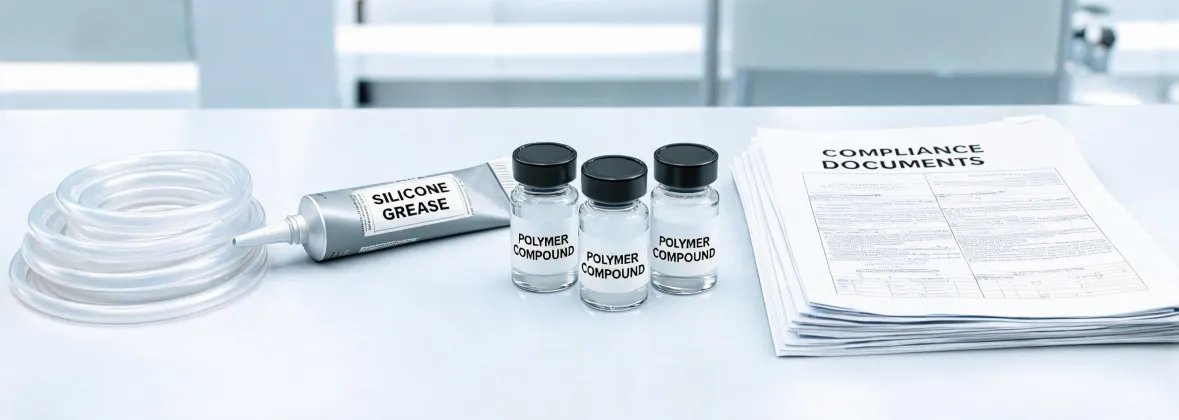
The second pattern is lubricant confusion. Silicone rubber parts sometimes need a compatible lubricant, especially in automotive or outdoor assemblies where a seal runs against moving hardware. Silicone grease is not all the same, and petroleum-based grease will degrade silicone rubber. That's why dealers sell Honda Shin-Etsu silicone grease—it's a silicone product designed for rubber weatherstrips and seals, and it's made by Shin-Etsu itself. People also use it on brake caliper pins because of its heat resistance and dielectric properties.
If you're sourcing a specialty silicone grease, the temptation is to search for the cheapest listing online. But the Honda Shin-Etsu silicone grease name is popular enough that counterfeit tubes show up in marketplace listings. I can't tell you exactly how often that happens, and I'm not going to make up a number. What I can tell you is that my team now orders through authorized Shin-Etsu silicone distributors, because they provide datasheets, lot traceability, and a straight answer about what compound is actually in the tube. The few dollars saved on an unlabeled listing aren't worth a service failure on a batch of 12,000 parts.
Silicone or Polypropylene: The Decision Framework
So which one should you choose? It depends on what the part does, and there's nothing wrong with saying that out loud.
Choose polypropylene when you need stiffness, dimensional stability, a living hinge, chemical resistance, or a cost-effective rigid structure in a high-volume product. It's a workhorse polymer, and I still specify it weekly.
Choose silicone when the part has to seal against moisture or dust, survive extreme temperatures, return to shape after compression, or provide a soft-touch surface. Silicone can look expensive per kilogram, but it often removes the need for secondary gaskets, adhesives, and mechanical fasteners.
The counterintuitive lesson from my failure is that the "expensive" soft material was actually the economical choice. The polypropylene lip saved me $0.45 per unit and then created a $26,800 warranty event. A molded silicone gasket would have cost more upfront and performed its job quietly for years, which is what most engineers actually need.
Before I approve any material spec now, I run through four questions:
1. Will this part ever be compressed, bent, or pressed and expected to return to its original shape? If yes, an elastomer like silicone needs to be in the drawing, not a thermoplastic. 2. Does the failure analysis include time and temperature extremes, or just data sheet values at room temperature? 3. Are the fluids, greases, or foam sprays that will touch this part documented by chemical family, not by brand name? 4. Can the supplier provide datasheets and traceability through an approved distributor?
I haven't stopped specifying polypropylene. I've just stopped pretending it can do a silicone part's job. That distinction has caught more potential errors in the last few years than I can count, and it costs nothing except a few extra minutes of checking before the order goes out. Five minutes of verification still beats five days of correction.