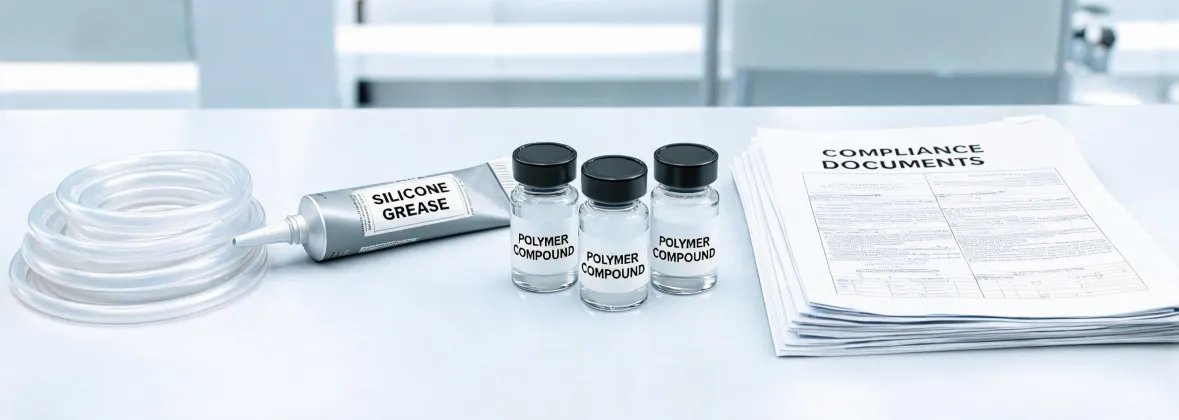
I've spent the last 7 years handling orders for industrial silicone components. Gaskets, greases, rubber profiles—you name it. In that time, I've made some doozies of mistakes. One of my biggest regrets: not understanding the difference between a silicone grease for a pump seal and a general-purpose lubricant. That misunderstanding cost a client $8,200 in rework and delays.
Here's the thing—this isn't a 'beginners make mistakes' story. I see seasoned purchasing managers and engineers make the same errors. They think they know what 'silicone grease' is. They don't.
The Surface Problem: 'It's Just Grease, Right?'
The call usually goes like this: someone needs a lubricant for a pump. They search 'silicone grease' or 'ptfe lubricant vs silicone.' They pick a cheap option, or one they've used before. The spec sheet looks fine. They order 50 tubes. The pump fails three months later.
I said 'silicone grease.' They heard 'any lubricant that says silicone on it.' Result: a $3,200 pump head replacement that should never have happened.
That's the surface problem: people assume silicone grease is a single, universal product. It's not. The difference between a food-grade silicone grease and a high-voltage dielectric compound is massive. Using one where you need the other is asking for trouble.
The Deeper Cause: A Taxonomy Problem
The real issue isn't laziness. It's that the industry naming convention is terrible. 'Silicone grease' covers everything from a cheap, non-reactive lubricant to a specialized thermal paste. A lot of suppliers don't help. They list 'silicone grease' without saying if it's for rubber-to-rubber compatibility, plastic-on-plastic, or high-pressure metal seals. You order 'Shin-Etsu silicone grease' and get something that's perfect for a valve but not for the pump you're building.
For example, a true Shin-Etsu silicone foam gasket needs a specific grease that won't degrade the foam. A standard PTFE-based lubricant will swell and destroy that foam in weeks. I've seen it happen. (Note to self: verify this against the Shin-Etsu chemical compatibility chart before recommending it.)
The deeper problem is that people don't realize they need to specify the application context, not just the material name. 'Silicone grease' is a category. You need to ask: 'What is the base polymer? What is the operating temperature? Is it for a static seal or a dynamic one?'
The Cost of Ignorance: Real Numbers
This isn't theoretical. Here's what I've seen just in the last 18 months:
- A $1,200 order of silicone grease that was incompatible with the client's EPDM seals. The grease caused the seals to harden and crack. Total cost: $3,800 in replacement parts plus 2 days of downtime.
- A line of 200 silicone foam gaskets ruined because the engineer used a PTFE aerosol lubricant instead of a Shin-Etsu-compatible silicone grease. The foam swelled by 15%. The gaskets couldn't be compressed into the assembly anymore. Cost: $1,100 wasted plus a 3-day production delay.
- A rush order for Shin-Etsu silicone rubber that failed within 6 months because the grease specified for the seal was a standard mineral-based lubricant, not a silicone-based one. The rubber degraded. The client had to replace the entire assembly. The service report noted the wrong lubricant. It was painful to read.
I still kick myself for one order in 2022. An $890 pump repair went sour because I approved a PTFE lubricant as a substitute. The client's spec said 'silicone grease' for the seal. The substitute worked for 3 months, then the seal failed. $2,500 in rework costs and a very unhappy client. If I'd just cross-checked the Shin-Etsu compatibility data, it would have been fine.
What Actually Works: A Framework, Not a Fix
So, how do you avoid this? It's not a simple checklist. It's a mindset shift. Here's what I use now, and it's cut our error rate on lubricant specs to nearly zero.
1. Ask the 'Why' Question Three Times.
When someone asks for 'silicone grease,' ask: 'Why? What specific property do you need?' If they say 'lubrication,' ask: 'For what substrate? Rubber? Plastic? Metal?' If they say 'rubber,' ask: 'What kind of rubber? EPDM? NBR? The Shin-Etsu range for silicone-compatible greases is different from the range for other polymers.'
2. Verify Against the Material Compatibility Chart.
This is the single most important step. Every Shin-Etsu silicone grease has a compatibility data sheet. It lists which materials it's safe with and which it's not. Use it. I'd say 90% of the mistakes I've seen could have been avoided by a 30-second check of that chart.
3. Specify by Application, Not by Product Name.
Don't write 'Shin-Etsu silicone grease' on a spec. Write: 'Silicone grease for use on EPDM seals in a pump with operating temp of -40 to 200C, requiring FDA compliance (unfortunately, not all greases are food-grade).' Then, let the supplier (or your internal team) match the exact product. You're not the expert on every grease. You're the expert on the application.
4. Test Before You Commit to Volume.
I ordered 100 tubes of a grease once because it looked perfect on paper. The first batch of samples worked fine. The production batch? The viscosity was wrong for the dispenser. The production line was down for 2 hours while we switched. The numbers said go with the cheaper bulk order. My gut said 'order a sample batch first.' Went with the numbers. Later learned that the batch variation in viscosity was a known issue the vendor had flagged (in fine print). Gut check for the win.
There's something satisfying about a perfectly specified order. After all the mistakes and stress, seeing a pump run for 3 years without a seal failure—that's the payoff. The best part: knowing that the $8,200 mistake I made three years ago is now a rule that prevents a dozen other people from making the same error.
If you're ordering silicone components, don't assume you know the product just because you know the name. The cost of that assumption is measurable. And it's zeroed out for me, as of January 2025, at least.