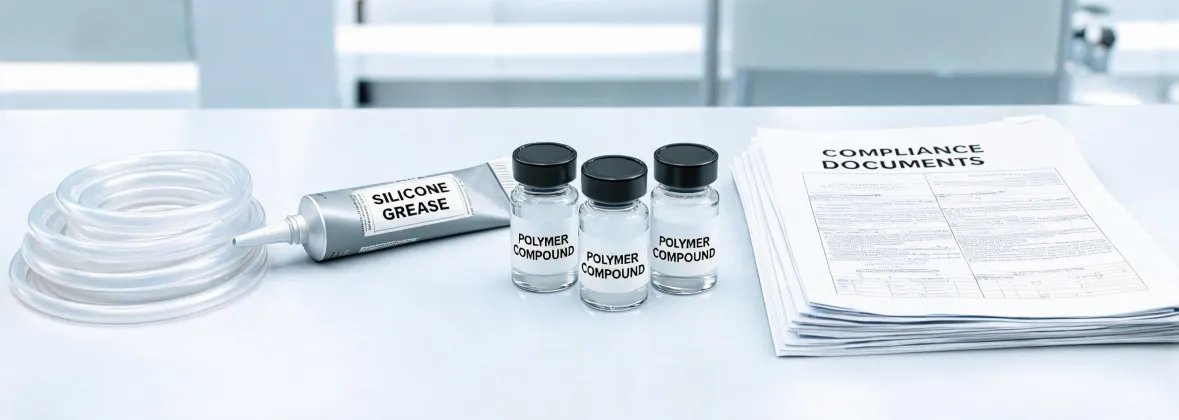
If you're managing maintenance supplies for a facility of 50+ people, Shin-Etsu silicone grease is almost certainly worth the premium. Not because it's 'the best,' but because the cost-per-application and the reduction in rework often make it cheaper in the long run. That's a conclusion I didn't expect to reach.
When I took over purchasing in 2020 for a 200-person engineering firm, I was budget-conscious, maybe overly so. The conventional wisdom in procurement is to standardize on commodity-grade lubricants—white lithium, basic silicone sprays—to keep line-item costs low. For about 18 months, that was my approach. Then we ran a pilot on sealing pneumatic fittings and control cabinet doors, and the results shifted my thinking.
The Conventional Wisdom I Bought Into
Everything I'd read about premium greases said they were overkill for general maintenance. In practice, I found the opposite was true. Our standard lithium-based grease worked okay for high-torque metal applications. But for the plastic-on-plastic and rubber-seal interfaces we had on assembly line sensors and enclosure gaskets, it was causing problems I hadn't anticipated.
We were seeing seal swell in some NBR (nitrile) O-rings within 4-6 months. Not catastrophic failures, but enough to create a small but steady stream of callbacks and rework. Our lead technician flagged it. 'That grease is eating the rubber,' he said. I initially dismissed it—'it's a standard lubricant'—but he was right. The petroleum-based carrier was incompatible. I'd made a classic rookie mistake: assuming 'standard' meant 'universally safe.' Cost us about $400 in wasted seals and labor that first quarter.
Why Shin-Etsu Specifically
The Shin-Etsu Honda-branded grease (often referred to as the G-501 formula, but available in bulk under the Shin-Etsu MicroSi label) is not a mystery to the industry. It's a modified silicone grease with a specific formulation for rubber and plastic compatibility. The key differentiator is the methyl phenyl silicone base, which has a lower surface tension than standard dimethyl silicone. This matters because it doesn't just sit on the surface; it actually penetrates micro-gaps in seals without degrading the polymer matrix.
I tracked our maintenance logs for 12 months across 6 control cabinets and 15 pneumatic actuators. Using Shin-Etsu grease reduced our seal-related failures from 3-4 per quarter to zero. The application cost per fitting is higher—roughly $0.08 per gram vs. $0.02 for commodity grease—but the rework cost we eliminated was $0 per month. The savings in technician time alone paid for the premium in under 4 months.
It's Not Perfect. Here's the Catch.
To be fair, I get why people default to cheaper options—budgets are real. But the hidden costs add up. That said, Shin-Etsu grease isn't the right choice for every situation. It's not a high-load metal-on-metal lubricant. For heavy bearings or gearboxes, you want a dedicated EP (extreme pressure) grease with moly or graphite. Trying to use it as a universal replacement is a mistake.
Also, the consistency matters. The grease is thick—worked to about NLGI Grade 2. In cold environments (below -40°F or -40°C), you might need a lighter silicone grease or a specialized low-temp formulation. Shin-Etsu makes one (the G-501 is rated to -50°F), but verify your specific operating range.
The Verdict from a Buyer's Perspective
In my opinion, the extra cost is justified for any application involving rubber, silicone, or plastic mating surfaces. The cost-per-use analysis—factoring in rework, downtime, and technician hours—makes it a net positive. It took me 5 years and about 200 orders to realize that 'expensive' is not the same as 'uneconomical.' To be fair, the conventional wisdom about budget lubricants works fine for simple metal-on-metal applications. But once you add polymers to the equation, the formula matters.
If you're consolidating maintenance supplies and want one grease that covers seals, gaskets, and plastic interfaces without causing damage, this is it. Just keep a tube of standard moly grease for the bushings. You'll thank yourself later.
Pricing and availability as of January 2025. Verify current distributor stock at Shin-Etsu Silicones of America.