Let me start with the question everyone types into Google: what is silicone rubber?
The short answer? It's a synthetic elastomer made from silicon, oxygen, carbon, and hydrogen. The useful answer? That's only the beginning. If you've ever ordered silicone rubber parts for a production line, you know that "silicone" on a spec sheet is about as specific as saying "metal." It tells you the family, not the material.
I'm the office administrator for a 200-person manufacturing company. I handle roughly $500,000 a year in material and component orders, process 60 to 80 purchase orders annually, and manage about a dozen vendors. I report to both operations and finance. I've been doing this since 2020, and one of the biggest surprises has been how much I needed to learn about materials—especially silicone elastomers.
This isn't a chemistry lecture. It's a buyer's guide to why silicone rubber orders go wrong, and what to ask for before you approve the next PO.
The Surface Problem: "Silicone Rubber" Is Vague Enough to Fail
Here's the familiar scenario. A maintenance manager asks you to order "silicone rubber gaskets." You search online, find a supplier, pick a hardness, choose a thickness, place the order. The parts work for a while. Then they harden. Or crack. Or swell when they touch the wrong fluid. And you're left thinking, "I ordered silicone. Why did this fail?"
That's the surface problem. It feels like a materials failure. But it's actually a specification failure.
So what is silicone rubber, really? It's a broad category. There are high-consistency rubbers (HCR), liquid silicone rubbers (LSR), room-temperature-vulcanizing (RTV) silicones, and more. Each one may have a different curing chemistry, different heat resistance, different mechanical properties, and different regulatory approvals. Silicone elastomers are not one material—they're a family of materials.
If you've ever bought a kitchen spatula, a phone case, a medical tube, or one of those squishy "silicone animals" for teething toddlers, you've touched this family. They all feel rubbery. They all look similar. But the difference between a spatula-grade silicone and a seal-grade silicone can be the difference between a tiny component cost and a costly recall.
The Deeper Problem: Most Orders Are Built on Assumptions
Here's what I learned the hard way: procurement people often don't know the right questions to ask, and generic suppliers won't volunteer the answers. I didn't even know the right questions until a bad order forced me to learn.
In our 2024 vendor consolidation project, one candidate offered silicone elastomer components at 15% below our current supplier. The samples looked identical. Same hardness, same feel, same color. The numbers said go with the new vendor. My gut said stick with the existing supplier, because they gave us detailed technical documentation and the new vendor only wanted to talk price.
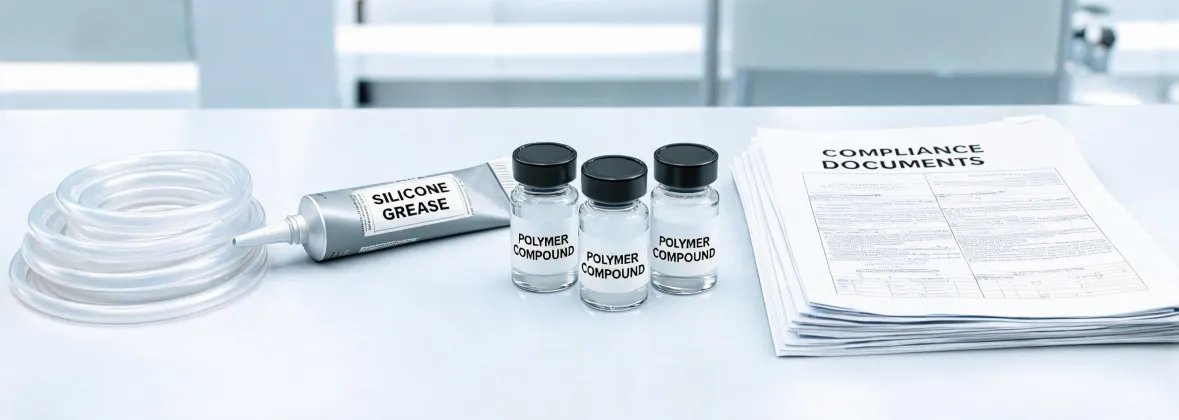
I almost overrode my gut. Then I asked the new vendor for a full data sheet: tensile strength, tear resistance, compression set, heat aging, and any food-grade or medical-grade certifications. They went quiet. A week later, they sent a one-page document with a logo on top and no test data.
That's a red flag. If a supplier can't show you what their silicone is made of, you're not buying silicone. You're buying a guess.
And that matters more than you'd think. Under FTC rules, a claim like "food-grade" has to be truthful and substantiated. But in B2B purchasing, you don't wait for the regulator to check. You verify before you order. The data sheet is your protection.
"FTC advertising guidelines require that claims be truthful, not misleading, and substantiated with evidence."
Let me also be clear about what not to do: don't rely on "I'm pretty sure it's the same material." I've made that mistake. It's the most expensive sentence in procurement.
The Real Cost of Getting It Wrong
I'll give you two examples from my own files.
Example 1: The grease that wasn't.
Our maintenance team used a specific shin etsu silicone grease for bearings on a packaging line. I saw a cheaper "generic silicone grease" from a new vendor and ordered it to test. The invoice was accurate. The material looked right. But the generic product didn't have a technical data sheet, and it failed under load within three weeks. We lost a day of production, paid overtime for a rebuild, and ended up with $2,400 in rejected expenses because the vendor couldn't provide proper documentation for the warranty claim. The savings on that original order: $86.
Example 2: The "food-grade" seals that weren't.
We also ordered food-grade silicone rubber seals for a filling machine. The price was too good to ignore. The supplier certified them as food-grade. But when the seals arrived, the hardness was different from the sample. They admitted they'd substituted a "similar" compound. It didn't happen to contact food yet, but if it had, that's exactly the kind of thing that gets a supplier on an FTC radar—and a manufacturer in the headlines.
This is what people don't tell you about the cheaper option. The real cost isn't the unit price. It's downtime. Rework. Compliance risk. And the moment you have to explain to your VP why the line stopped because of a material you approved.
Why Certainty Is Worth a Premium
If any of this sounds familiar, you know the feeling. After getting burned by "probably on time" and "basically the same" promises, we changed our buying philosophy.
In March 2024, we needed a rush order of LSR tubing for a customer trial. The standard lead time was three weeks. The trial was scheduled in ten days. We paid an extra $400 for expedited service from our regular distributor. My finance person questioned the rush charge. But the alternative was missing a $15,000 customer trial and losing the account.
So glad I paid for the certainty. Almost went with a different supplier who promised "maybe six days." We would have missed the trial entirely.
In procurement, "guaranteed" can feel like a luxury. But in an emergency, guaranteed delivery isn't an upsell—it's insurance. The same logic applies to material quality. A supplier who can tell you what is silicone rubber, what grade you need, and what tests back that up is worth more than a supplier who says, "It's all the same."
What Actually Helped (And It's Not Complicated)
You don't need to become a polymer chemist. You just need to add a few habits to your ordering process:
- Specify performance, not just material name. Hardness is a start, but ask for tensile strength, elongation, compression set, heat rating, fluid compatibility, and certifications.
- Ask for the technical data sheet before you ask for a quote. If a supplier hesitates, that's your answer.
- Verify third-party certifications yourself. For food contact, look for FDA or EU compliance statements. For flame resistance, look for UL ratings. For medical use, ask for ISO 10993.
- Use named products when you can. For grease, I now order shin etsu silicone grease by full part number and check the label when it arrives. For elastomers, I name the specific grade and cure system.
- Follow supplier news. I subscribe to shin-etsu silicone news alerts. It sounds nerdy, but when a product is discontinued or upgraded, you hear about it before your alternate supplier does.
And yes, those "silicone animals" I mentioned earlier? Same chemistry family, completely different grade. That's the point. What is silicone rubber? It depends on who makes it, what's in it, and what your application demands. The sooner you treat it that way, the fewer surprises you'll have.
This advice was accurate as of Q1 2025. Product lines, certifications, and market conditions change fast, so verify current specs before you commit. I learned that the expensive way.