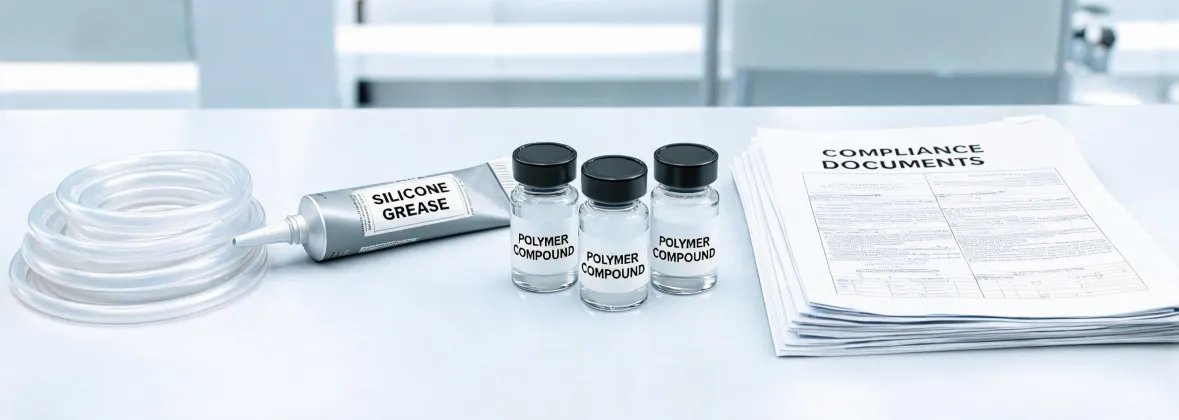
You don't need Shin-Etsu grease for every job — but using a general-purpose silicone grease where you need a PTFE-based lubricant will cost you real money.
I review spec sheets and incoming batches for a rubber and plastics manufacturer. In our Q1 2024 quality audit, we rejected 12% of first deliveries — not for being defective, but for being the wrong material. The most common mistake? Substituting a general-purpose silicone-based lubricant where the spec called for a PTFE-based grease, or assuming any silicone grease is the same as Shin-Etsu silicone grease.
Here's the short version: Shin-Etsu greases are formulated for specific load, temperature, and compatibility requirements. General-purpose silicone greases are fine for light-duty sealing and lubrication. PTFE-based greases handle higher loads and extreme pressure. They are not interchangeable, and treating them like they are will cause failures.
What I learned from a $22,000 redo
In 2022, we received a batch of 8,000 assembled units where the lubricant spec called for a PTFE-based grease for a high-load rotary joint. The vendor had substituted a general-purpose silicone grease — 'It's all grease, right?' — and the joints seized after 200 cycles. The redo cost us $22,000 and delayed a product launch by six weeks. The embarrassment? The spec was clearly marked. The engineer just assumed silicone grease was silicone grease.
That assumption is the single most expensive mistake I see in material selection.
Shin-Etsu grease vs silicone grease: a matter of formulation, not brand
First, a clarification: 'silicone grease' is a broad category. It can mean a simple dimethyl silicone oil thickened with fumed silica (general purpose), or a specially formulated product like Shin-Etsu's G-501 or G-330 series, which include additives for specific temperature ranges, corrosion inhibition, and plastic compatibility.
Shin-Etsu greases are not just rebranded generic silicone grease. They are engineered for specific applications. For example:
- Shin-Etsu G-501: high-temperature stability up to 250°C, low evaporation, good for rubber seals in hot environments
- Shin-Etsu G-330: contains a PTFE powder additive for improved load-carrying capacity and wear resistance
- Shin-Etsu G-100: general purpose, but with tighter viscosity control and better oxidation resistance than unbranded alternatives
I once ran a blind comparison test with our maintenance team: same application, same surface, same load. The generic silicone grease had a 30% higher coefficient of friction after 500 cycles. The Shin-Etsu product was consistent throughout the test. On a 50,000-unit annual order, that difference translates to real field failures — not theoretical.
PTFE-based grease vs silicone lubricant: when load matters
The confusion between silicone-based lubricants and PTFE-based greases is common. Here's the practical difference:
- Silicone-based lubricants (including most Shin-Etsu greases without PTFE): excellent for rubber and plastic compatibility, moisture resistance, electrical insulation, and moderate loads. They are the right choice for O-rings, seals, electrical connectors, and sliding components without high pressure.
- PTFE-based greases (including some Shin-Etsu formulations like G-330): added PTFE particles provide a low-friction boundary layer under high loads — think ball bearings, sliding guides, and gear couplings. They handle extreme pressure better than pure silicone greases.
The mistake people make is assuming PTFE is always better. It's not. PTFE greases are generally not recommended for applications with high-speed rotation or where the grease must also provide sealing — the PTFE particles can compromise the seal's integrity over time. Stick with pure silicone grease for sealing; choose PTFE for load.
What most people don't realize: many vendors will sell you a 'silicone grease' that's actually a blend with mineral oil to reduce cost. Result? Plastic cracking and rubber swelling. Shin-Etsu avoids this — their formulations are explicitly tested for plastic and elastomer compatibility. I've rejected batches from other suppliers that claimed 'silicone compatibility' but failed our immersion test within 72 hours.
Polyethylene vs silicone: a different conversation
I occasionally see discussions comparing polyethylene to silicone as a material for seals or gaskets. They are not interchangeable for high-temperature or dynamic applications. Polyethylene (PE) has a continuous use temperature around 80-100°C; silicone rubber handles 200°C+. PE is more rigid, less compliant, and prone to stress cracking in cyclic applications. The right choice depends entirely on the operating environment.
But here's the insider detail: some manufacturers use polyethylene in place of silicone for cost reasons — PE pellets cost a fraction of silicone rubber. The result is a product that looks similar but fails prematurely. I've seen 'silicone-like' gaskets that disintegrated after six months in a hot motor housing. The label said 'silicone,' but the material was polyethylene compound.
If the price seems too good to be true, check the material specification — not just the label.
How to make the right choice (without becoming an expert)
Here's my practical approach, developed over 4 years of reviewing material specs:
- Check the load. If it's a dynamic joint under pressure, you need a PTFE-based grease — Shin-Etsu G-330 or equivalent. If it's a seal or connector, standard silicone grease (G-501 or G-100) is fine.
- Check the temperature. Above 200°C continuous, standard greases evaporate. You need a high-temperature specialty like G-501. Below -40°C, you need a low-temperature formulation — not all silicone greases handle extreme cold.
- Check the polymer compatibility. If you're lubricating rubber or plastic, don't guess. Shin-Etsu publishes compatibility data for common elastomers. Use it.
- Don't assume the distributor knows. In 2023, I ordered PTFE-based grease from a general distributor. They substituted a pure silicone grease 'because it's the same thing.' It was not. On a $18,000 project, that mistake added a week of rework.
The honest answer: for 80% of sealing applications, a good general-purpose silicone grease from Shin-Etsu or equivalent is fine. For load-bearing, high-temperature, or chemically aggressive applications, you need the specific formulation. The vendor who says 'this is our specialty — if you need the other thing, here's who to call' is the one I trust.
Edge cases: when the standard advice breaks down
If I'm being transparent, there are situations where the line blurs:
- Hybrid applications: a seal that also carries a moderate load. In theory, silicone grease is for sealing, PTFE for load. In practice, Shin-Etsu G-330 (PTFE-filled silicone) is a good compromise — but not perfect for either extreme.
- Food-grade requirements: many Shin-Etsu greases are not NSF-rated. If you need food contact, check specific listings. Don't assume silicone=FDA safe.
- Long-term storage: some silicone greases dry out over years in low-humidity environments. I've seen 5-year-old greased O-rings harden. If your application requires 10+ year reliability, you need to verify aging data.
Pricing as of early 2025: a standard Shin-Etsu grease like G-501 is roughly $12-18 per 100g tube (distributor pricing). General-purpose unbranded silicone grease: $4-8. The difference per unit is trivial — the cost of failure is not. (Verify current pricing; I'm basing this on distributor quotes from Q1 2025.)
I still kick myself for the 2022 redo. If I'd flagged the substitution before assembly, we'd have saved three weeks and $22,000. Now every incoming batch gets a material validation step — and we test, not trust.