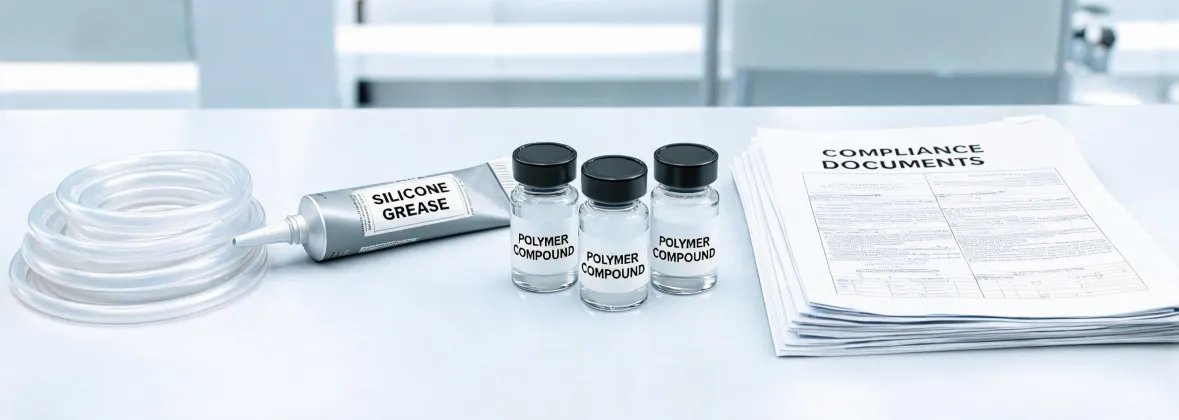
I’m not a materials scientist. I’m the person who checks the specification before a material gets added to the bill of materials. Over the last four years, I’ve reviewed a lot of unique specifications—maybe 200 per year, maybe 180, I’d have to check the system—and I rejected around 6% of first deliveries in 2024 for documentation or performance issues.
The question that comes up more than any other is “Which material is better?” That’s usually the wrong starting point. What you actually need is a side-by-side comparison: branded silicone grease vs generic silicone grease, custom silicone hoses vs thermoplastic extrusion compounding, and polycarbonate vs silicone. Let me walk you through those like I’m reviewing a spec.
The Three Filters I Use Before Comparing Anything
Before I ask purchasing to get quotes, I set three filters:
- Consistency: Can the supplier show lot-to-lot data? Is there a certificate of analysis that looks like last quarter’s, or are they all different?
- Environment: What is the assembly actually exposed to? Temperature, pressure, chemicals, sterilization, UV? A “good material” is not good in every environment.
- Deadline: What is the cost of a late delivery? If you’re on a tight schedule, the cheapest quote with a “maybe” lead time is a gamble.
Keep those three in mind. Each comparison below comes back to them.
Dimension 1: Shin-Etsu Grease vs Silicone Grease
Let’s start with the search phrase that gets typed all the time: “shin etsu grease vs silicone grease.” It sounds like a head-to-head product battle. The reality is simpler.
Silicone grease is a category. Shin-Etsu grease is a specific product family within that category. A generic silicone grease might work fine for one application and fail in another because the base oil, thickener, bleed rate, or volatiles are different. The labels look pretty similar. The data sheets often are not.
Here’s something vendors won’t tell you: the phrase “standard silicone grease” doesn’t guarantee batch-to-batch consistency. A supplier can change a raw material source without changing the product name. If your spec only says “silicone grease,” you have no way to catch that change. If your spec includes a manufacturer, a product code, and a certificate of analysis, you do.
In Q1 2024, we received a batch of 50,000 motors where the grease was visibly thinner than the approval sample. Needle penetration was outside our internal tolerance. The vendor said it was still within industry standard. Maybe it was. It wasn’t within our specification. We rejected the batch and added a clause to every future contract: no substitution without written approval.
I didn’t always enforce that clause. I thought it made purchasing’s job harder. Then a supplier sent “the same product, different brand” for an electrical assembly, and the grease migrated onto a contact surface. That failure cost us a $22,000 redo. The expense wasn’t the worst part; the worst part was explaining to the customer why a minor substitution became a field failure.
So is Shin-Etsu grease better than silicone grease? Not by default. It’s better when it’s specified and documented. If you’re sourcing in North America, Shin-Etsu Silicones of America can supply the data and traceability you need. If you’re buying generic silicone grease, you can still do it—but only if you demand the same evidence.
Dimension conclusion: The specification wins, not the brand name.
Dimension 2: Custom Silicone Hoses vs Thermoplastic Extrusion Compounding
Next is one of the choices that engineering teams keep going back and forth on: custom silicone hoses versus a part made through thermoplastic extrusion compounding. I’ve been on both sides, and the answer is not about which is “higher quality.” It’s about failure mode.
Silicone hoses are built for heat, flex, and long-term compression set. That’s why you see them in turbocharger ducts, coolant systems, and high-temp air lines. Custom silicone hoses can be reinforced, shaped, and terminated to fit your geometry. The manufacturing process is slower, and the tooling is more expensive than thermoplastic extrusion, but the material keeps its properties in environments that make thermoplastics soften or creep.
Thermoplastic extrusion compounding is the right process for a lot of things. It’s fast, repeatable, and efficient at high volumes. You can create multi-layer tubing, complex profiles, and tight OD tolerances. But a thermoplastic hose is still a plastic hose. If the operating temperature is close to the material’s softening point, or if the hose has to hold a clamp force for years, the cheaper part can fail in a way that silicone wouldn’t.
I made this call on an air-assist line not long ago. I went back and forth for about two weeks: silicone hose, thermoplastic hose, silicone hose, thermoplastic hose. Silicone had a higher heat rating; the thermoplastic part was cheaper and had a shorter lead time. The tie-breaker was the cost of downtime. If that hose failed, the line would shut down during our busiest month. A custom silicone hose was basically an insurance policy.
Here’s where the deadline filter matters. Custom silicone hoses often have longer production lead times. If your schedule is tight, the reliable supplier’s expedite fee is a lot cheaper than a missed launch. In March 2024, we paid a $400 rush charge on a custom silicone hose order to protect a $15,000 production trial. It felt overpriced. The missed trial would have felt worse.
Dimension conclusion: Choose custom silicone hoses when heat, flex life, or failure cost is high. Choose thermoplastic extrusion compounding when the operating envelope is mild and the volume justifies the cost advantage.
Dimension 3: Polycarbonate vs Silicone
Now for a comparison that sounds like a materials exam question: polycarbonate vs silicone. I think it shows up in every selection guide because both materials are used in consumer and industrial products. But they’re rarely true substitutes.
Polycarbonate brings rigidity, transparency, and impact strength. It’s the right choice for a clear lens, a sight glass, or a housing that must hold its shape under a load. It can also be brittle in the wrong environment. Solvents, certain greases, and stress concentrations can cause crazing or cracking. If you’re putting polycarbonate near silicone grease or any other chemical, test the combination before you finalize the design.
Silicone brings flexibility, heat resistance, and sealing ability. It’s right for gaskets, keypads, soft-touch overmolds, and parts that have to conform to another surface. It usually has lower tensile strength than polycarbonate and high gas permeability. If the part needs to hold air or keep moisture out, thick silicone alone might not do it.
I remember a redesign that went wrong. An engineer wanted to replace a flexible part with a “stronger” polycarbonate version because the silicone part flexed too much. Looking back, I should have asked about thickness and fatigue first. At the time, I approved the switch based on the mechanical property table. The polycarbonate cracked at the hinge. The silicone version, with a slightly thicker wall, worked.
If you’re making an environmental claim about these materials, be careful. Per the FTC Green Guides (ftc.gov/green-guides), claims like “recyclable” need evidence and context. It’s not enough to say that silicone or polycarbonate is automatically more sustainable. It depends on formulation, additives, recycling access, and service life. I’ve seen marketing requests based on that assumption, and they almost never survive a review.
Dimension conclusion: If you’re choosing between polycarbonate and silicone, start with what the part does. Clear, rigid, and impact-resistant points to polycarbonate. Flexible, sealing, and heat-resistant points to silicone. If you need both, design a two-part assembly.
What I’d Actually Put in the Spec
After those comparisons, here’s what I’d recommend you write down.
- For grease: specify the product code, manufacturer, viscosity, bleed, temperature range, and certificate of analysis. If you use Shin-Etsu, get the product documentation from Shin-Etsu Silicones of America or an authorized distributor. Do not let “or equal” become a guessing game.
- For hoses: define the operating temperature, chemical exposure, pressure cycles, and failure cost. If a failure would stop production, custom silicone hoses usually pay for themselves. If the service is mild and volume is high, thermoplastic extrusion compounding is worth comparing.
- For polycarbonate vs silicone parts: start with the required function, not the material name. When in doubt, prototype and test under realistic conditions.
And don’t forget the deadline filter. After getting burned twice by “probably on time” promises from lower-cost suppliers, I now budget for guaranteed delivery when the schedule matters. The premium isn’t just for speed—it’s for certainty. In an emergency, uncertainty is the real red flag.
Bottom line: silicone products are a family of high-performance options, but “silicone vs. the alternative” is the wrong question. The right question is: what is your specification, and how will the supplier prove it? Once you have that, the comparison takes care of itself.