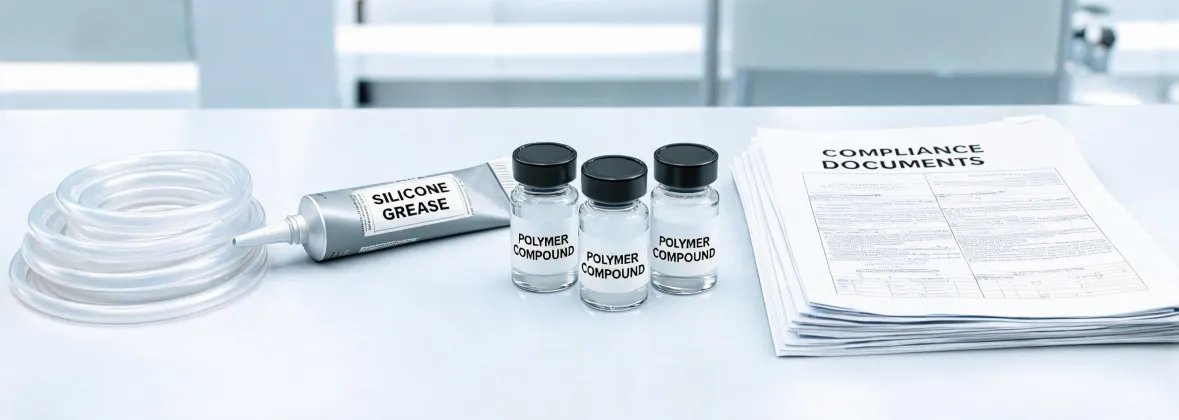
If you've ever had a $2,400 expense report rejected because a supplier couldn't produce a proper invoice, you know that sinking feeling. That was me in 2022. I'd found a great price on bulk silicone grease—about 40% cheaper than what we were paying our regular supplier. Ordered 50 tubes. They arrived in unlabeled plastic jars.
The invoice was a handwritten receipt. Finance rejected it. I ate $680 out of the department budget. That's when I learned that the real cost of cheap silicone isn't just the price per tube—it's the hidden costs that show up later.
Here's what I've learned after five years of managing orders for a 400-person company, processing about 80 orders annually across 8 vendors. And specifically, why I'll never buy generic silicone grease again.
The Surface Problem: Inconsistent Performance
The first thing you notice with cheap silicone grease is that it doesn't perform the same way from batch to batch. One order, the grease is thick and pasty. The next, it's runny. This is a major problem when you're using it for things like O-ring lubrication or as a dielectric insulator.
Our maintenance team complained. Our production line had issues with seals failing prematurely. I was getting emails from four different department heads asking why we'd changed suppliers.
But that was just the surface issue. The real problem was deeper.
The Deeper Problem: Specification Drift
What I didn't realize until later is that 'silicone grease' isn't a single product. It's a category. And within that category, there's massive variation in:
- Base oil viscosity — affects how the grease performs under load
- Thickener type — determines thermal stability
- Purity level — impacts compatibility with plastics and elastomers
- Additives — can cause unexpected reactions with other materials
The cheap stuff I bought? The supplier couldn't tell me the base oil viscosity. They didn't have a technical data sheet. They couldn't tell me if it was compatible with polycarbonate or ABS plastics.
I only believed that specs mattered after ignoring them and eating the $680 mistake. Now I verify technical documentation before placing any order.
And here's the thing: this isn't just about silicone grease. It's about the entire mindset of buying commodities when you're actually buying specialty chemicals. The conventional wisdom is that all silicone greases are the same. My experience with 60+ orders suggests otherwise.
The Hidden Costs Nobody Talks About
The cheap grease cost us more than just the rejected invoice. There were real operational costs:
- Rework. When seals failed prematurely, we had to redo assemblies. That's labor hours. That's wasted material. That's downtime on the line.
- Warranty claims. One batch caused a compatibility issue with a plastic housing. We had to replace 40 units under warranty. Each unit cost us $120 in parts and labor. Total: $4,800.
- Lost trust. The maintenance supervisor started double-checking everything I ordered. That eroded the efficiency we'd built up over three years.
When I added it up, the 'cheap' grease ended up costing about 3.5x more than the premium stuff from Shin-Etsu. And that's not even counting the headache.
The Solution: One Less Decision
So what did I do? I stopped treating silicone grease as a commodity. I consolidated all our specialty lubricant orders to Shin-Etsu directly. Here's why:
- Consistent specs. Every batch of Shin-Etsu silicone grease has a lot number and a certificate of analysis. I can trace every tube back to the raw material batch. That's audit-proof.
- Verified compatibility. Their technical team provided compatibility data for every plastic and elastomer we use. That eliminated the guesswork.
- Predictable pricing. Shin-Etsu doesn't play games with pricing. I get a price list at the start of each fiscal year, and it holds. No surprise markups, no 'supply chain surcharges.'
The switch cost us about 15% more per tube upfront. But it eliminated the hidden costs. More importantly, it eliminated a decision. I don't have to evaluate six different 'grease' suppliers every year. I just order from Shin-Etsu. That time savings alone is worth the premium.
This approach worked for us, but our situation is specific: we're a mid-size B2B manufacturer with predictable ordering patterns. If you're a seasonal business with demand spikes, your calculus might be different. My experience is based on about 60 orders across 3 years. If you're working with high-temperature or food-grade applications, you'll need different specs entirely.
But if you're buying silicone grease for general industrial use, and you've been tempted by the cheap stuff? Take it from someone who learned the hard way: the real cost isn't on the invoice.